Story 16 / A reading of Tolkien
Maedhros and Maglor: Bound by an Oath
The Oath does not make Maedhros and Maglor innocent. Its tragedy lies in how clearly they can feel the cost of obedience and still obey.
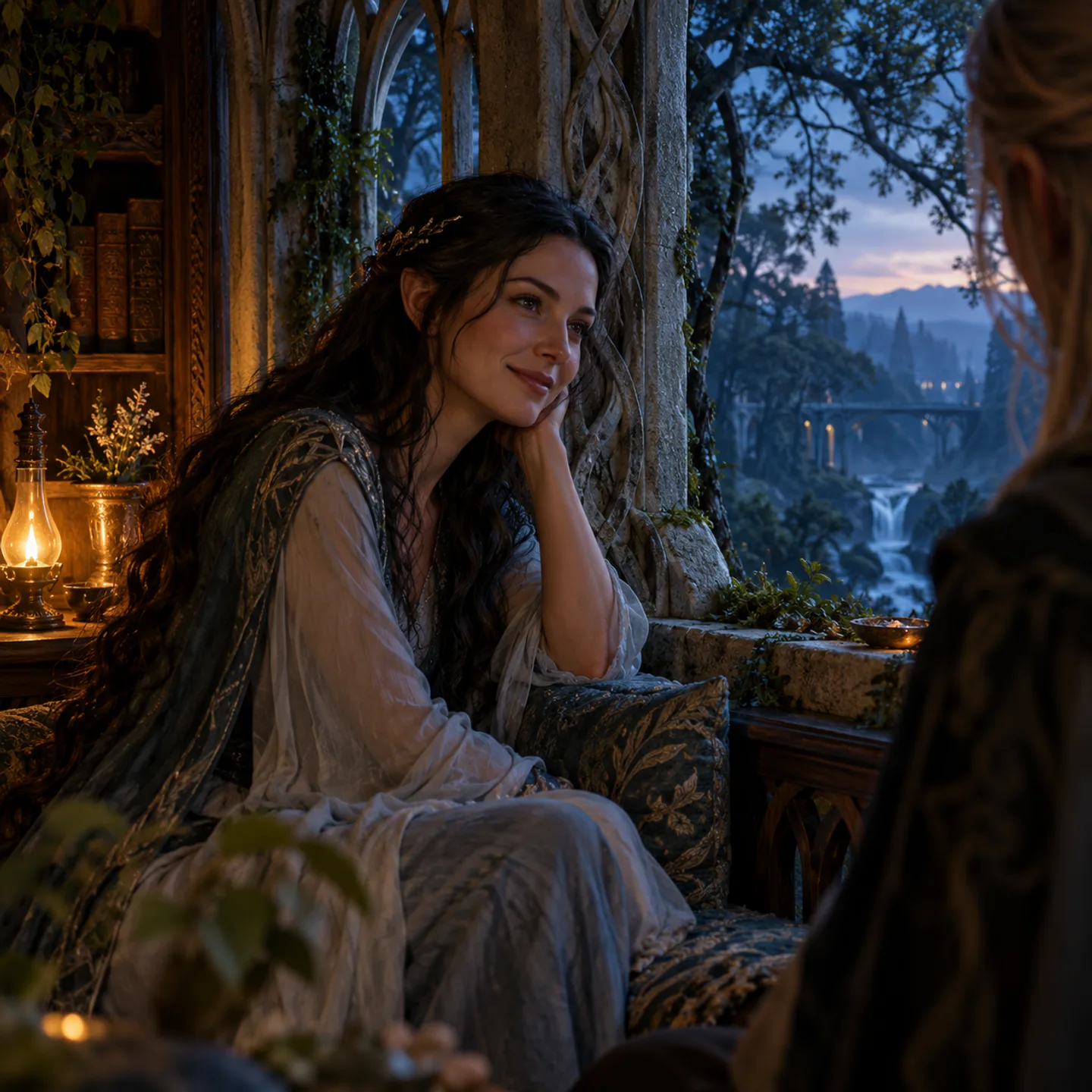
There is a kind of silence that belongs to people who have already understood the wrongness of what they are about to do. It is not innocence, and it is not peace. It is the pause before a hand closes around a familiar weapon, when memory has become a weight rather than a warning.
Maedhros and Maglor inhabit that pause more fully than almost any other figures in the First Age. Their story is not simply about an oath fulfilled through blood. It is about the narrowing of a moral world: how a promise can become more vivid than the people standing before it, how remorse can exist beside obedience, and how pity may arrive too late to prevent the wound. In my reading of the secondary accounts, hesitation makes the later violence harder—not easier—to bear.1234567
The promise outlives the purpose
The Oath begins in the history of the Silmarils, but its later force is detached from the original shape of that desire. By the time the Sons of Fëanor attack Doriath, the jewel recovered by Beren and Lúthien has come into Dior’s possession. The assault follows not because Dior has newly injured them, but because possession itself has become intolerable to the sworn claim. The secondary account records the deaths of Dior and Nimloth, along with Celegorm, Curufin, and Caranthir; Elwing escapes with the Silmaril. The promise has survived the destruction of the world it was supposed to serve.84357
This is where the Oath becomes more frightening than a simple curse. A curse might be imagined as an external pressure, something that descends upon the will and pushes it toward ruin. Tolkien’s moral architecture is less comfortable. The oath binds, but the brothers remain answerable. They do not become puppets. The language of compulsion can explain the terrible continuity of their actions, yet it cannot make the victims disappear from the room or turn violence into fate.
Maedhros and Maglor therefore move through a landscape in which intention and responsibility refuse to separate. Their desire has become an inheritance they cannot bear to abandon, but also cannot honour without violating others. The jewel is small. The consequence is not. Around it gather a dead king, a dead queen, broken families, and children whose fate becomes one of the quietest cruelties in the legendarium.84357
Doriath, and the children left behind
The secondary summary describes Dior’s sons, Eluréd and Elurín, being taken into the forest and abandoned after Doriath’s destruction. Their final fate is not resolved there. Maedhros later searches for them without success. That detail matters because it resists the cleaner shape of punishment: the brothers have not merely committed a crime and received an immediate moral answer. They are left with uncertainty, with the possibility that the children might have lived and the knowledge that they did not find them.843
Maedhros’s search is one of the few gestures in this story that moves away from possession. He does not recover the Silmaril. He does not repair Doriath. He cannot return the dead to their homes. He searches for children, and the search fails.
I cannot read that failed search as a good deed balancing the massacre. A search cannot become absolution merely because it is sorrowful. Yet it changes the emotional temperature of Maedhros’s story. Remorse is not abstract here. It has a direction, however helpless: into the forest, after those who were carried away from the ruins. The Oath has taught him to pursue an object. Guilt turns him toward persons, but too late and without power to undo what has happened.83457
The distance between Doriath and Sirion
After the destruction of Doriath, Elwing and other refugees settle at the Mouths of Sirion with the Silmaril. There, the surviving sons of Fëanor face a choice that the earlier attack had seemed to postpone. In the published account, Maedhros initially holds back because of what has been done at Doriath. He sends messengers before the assault, demanding the jewel, and the refusal of Elwing and the Havens is followed by the attack known as the third Kinslaying.81243
That interval is the central chamber of their tragedy. Maedhros hesitates. The hesitation proves that another response can still be imagined. It also proves that imagination is not the same as courage. He can see the shape of the coming crime, and yet the Oath remains stronger than the moral knowledge gathered against it.
There is no need to make Maglor and Maedhros identical in order to understand their bond. The published narrative does not give a precise individualized account of what each brother did during the assault on Doriath, and the collective force of the Sons of Fëanor should not be rearranged into private certainties. At Sirion, too, the emotional distinction between them must remain careful. The secondary account describes Maglor caring for the children. That care does not place him outside the violence. He is not the innocent brother who happened to arrive after the bloodshed. He belongs to the force that made the children captives.1234568
The cruellest victory
The assault on the Havens of Sirion is identified in the published narrative as the third Kinslaying and given its harshest moral framing. Elwing escapes by casting herself into the Sea with the Silmaril, so Maedhros and Maglor do not recover the jewel at Sirion. Elrond and Elros are captured after the attack, and Maglor takes them into his keeping. I read that reported care without treating it as restoration or assigning it one simple inner motive.12456
The children alter the meaning of the Oath without defeating it. Maglor can care for Elrond and Elros; he cannot make their captivity harmless. He can offer tenderness inside the aftermath of a crime, but the tenderness is surrounded by the fact that their parents’ refuge has been destroyed and their lives have been violently displaced.
Redemption feels too bright a word here. Care matters, but it does not settle the history of the children’s capture. The children are not instruments of his purification, and their safety does not retroactively sanctify the attack. If anything, their presence keeps the wound open. Every ordinary act of guardianship would have had to exist beside the knowledge of how they came into his hands.12456
Imagine a room after the fighting, a space in which no one knows what to do with quiet. A child is given food. A cloak is pulled closer around small shoulders. Beyond the walls, the sea keeps its own rhythm. Nothing in these gestures repairs Sirion. Their gentleness is real precisely because it has no power to make the past gentle.12456
The jewel refuses the claim
The secondary account describes the remaining Silmarils being stolen after the War of Wrath, not lawfully restored to the brothers; the jewels burn them. The Maglor summary places the theft after Eönwë refuses their demand. The published narrative ends with Maedhros casting himself into a fiery chasm with his Silmaril. Maglor casts his into the Sea and wanders along the shores in grief; his ultimate fate is left unrecorded.5743
The burning is not merely a supernatural verdict stamped onto the end of the story. It gives physical form to a moral recognition that the brothers have resisted: possession cannot restore legitimacy. They have obeyed the Oath, but obedience has not made the jewels theirs. The light they claimed rejects the hands that have carried their claim through so much suffering.
Here the brothers separate. Maedhros turns toward destruction, an end that is terrible but definite. Maglor remains beside the Sea, where the object of desire has vanished and no clear ending arrives to contain his grief. His fate is open, not comforting. The openness allows no invented pardon and no convenient death. He is left with the sound of water and the knowledge that renunciation came only after nearly everything else had been lost.5743
What the oath costs the living
Maedhros and Maglor are often remembered as brothers bound together by loyalty. That is true, but incomplete. Their bond is also a shared inability to step outside an inherited demand. I read their bond as one pressure within those later choices, not as proof that each brother felt or decided in the same way.
The tragedy is not that they lack feeling. They feel guilt, hesitation, pity, weariness. The tragedy is that feeling does not automatically become refusal. A person may understand the cost of an act and still place the act above the lives before him. That is my reading of responsibility beside anguish, not an explanation supplied by the Waldman letter for these two lives.1234567
The later Kinslayings should also remain distinct from the first Kinslaying at Alqualondë. The supplied textual tradition does not establish that Maglor personally participated in every act of the first assault; later reference material records his presence while leaving the degree of his participation uncertain. That uncertainty should not be used to excuse the later attacks, which the published narrative presents as separate events, with their own victims, decisions, and consequences.64910
At the end, the most painful image is not the jewel burning Maedhros or sinking from Maglor’s hands. It is the promise continuing until the future they sought has become impossible to keep. One brother disappears into fire. The other walks the shore with an unrecorded fate. Between them remains the shape of an oath whose pursuit has destroyed the very claim it was meant to defend.124573
The texts. Our interpretation.
Independent narrative criticism. Interpretations and imagined passages are distinct from Tolkien’s texts. Primary book passages were not directly opened: book references are locators, not claims of direct access. Official excerpts and secondary references are identified separately. Published accounts and later variants are kept distinct. Reading notes: The cruellest victory — It is possible to imagine a room after the fighting, not as a lost scene from Tolkien but as a space in which no one knows what to do with quiet.
Numbered notes identify the evidence behind this essay. An online summary is not a substitute for the original book; differing drafts and published versions remain separate.
- Third Kinslaying
The Silmarillion · Quenta Silmarillion, Of the Voyage of Eärendil and the War of Wrath; secondary summary with an Other versions section
Secondary reference. Not the original text. - Of the Voyage of Eärendil and the War of Wrath
The Silmarillion · Quenta Silmarillion, Of the Voyage of Eärendil and the War of Wrath; secondary chapter summary
Secondary reference. Not the original text. - Maedhros
The Silmarillion · Character reference; sections on Doriath, the Mouths of Sirion, and the aftermath of the War of Wrath
Secondary reference. Not the original text. - The Silmarillion
The Silmarillion · Quenta Silmarillion, Of the Flight of the Noldor; Of the Ruin of Doriath; Of the Voyage of Eärendil and the War of Wrath
Book / section reference. No online text verified. - Maglor
The Silmarillion · Character reference; sections on the Kinslayings, Elrond and Elros, and the last Silmaril
Secondary reference. Not the original text. - Maglor
The Silmarillion; The Letters of J.R.R. Tolkien; The History of Middle-earth · Character article, especially sections on Alqualondë, Doriath, Sirion, and post-War of Wrath material
Secondary reference. Not the original text. - Sons of Fëanor
The Silmarillion · Encyclopedia of Arda reference entry for the Sons of Fëanor
Secondary reference. Not the original text. - Second Kinslaying
The Silmarillion · Quenta Silmarillion, Of the Ruin of Doriath; secondary summary with an Other versions section
Secondary reference. Not the original text. - The History of Middle-earth, Volume IV: The Shaping of Middle-earth
The History of Middle-earth · Volume IV, The Shaping of Middle-earth; early versions of the Quenta and related material concerning the Oath and the later Kinslayings
Book / section reference. No online text verified. - The Letters of J.R.R. Tolkien
The Letters of J.R.R. Tolkien · Letter 246, 1963, and Letter 297, 1967, for Tolkien’s comments on moral responsibility, pity, and the use of power; applicability to this episode requires manual checking
Book / section reference. No online text verified.