Story 04 / A reading of Tolkien
The First Awakening: Before the Darkness Had a Name
Before the Elves had histories, they had one another, the stars above them and a world not yet fully named.
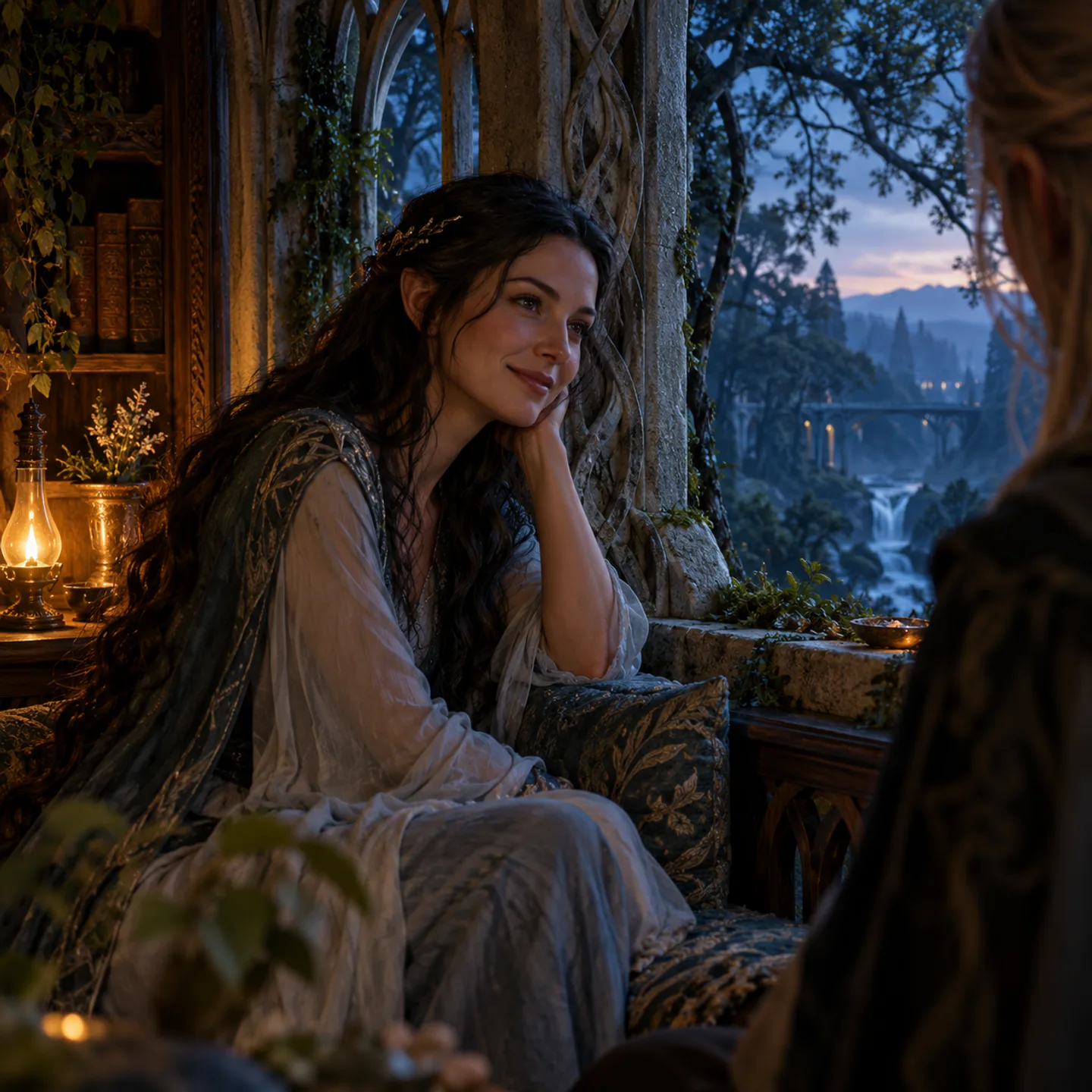
The Elves’ beginning is tender because it is not presented as a triumph. No city rises. No crown is placed upon a head. The first light of their story is the light of stars over water, and the first community Tolkien gives them is still exposed to everything that has not yet been understood.
Cuiviénen, the Water of Awakening, belongs to the eastern regions of Middle-earth in the published tradition. Its geography is deliberately safer when left broad: a water, a shore, a place beneath the stars, rather than a fully furnished map. The details matter less than the condition. The Elves begin at the edge of knowledge. They are awake, but the world around them is not yet secure.1234
A beginning without a shelter
Tolkien Gateway’s summary of the published Silmarillion places the first awakening at Cuiviénen during the Years of the Trees. The Elves open their eyes beneath the stars, before the Valar have learned that the Children of Ilúvatar exist. The stars associated with Varda are part of this first cosmic orientation, while Oromë’s later discovery begins the movement by which their existence becomes known in Valinor.1234
That order gives the awakening its quiet unease. The supplied summary places their awakening before Oromë’s discovery. I do not make that interval proof that no power knows or watches them. The stars are present, but no welcoming procession arrives beneath them. The first world is therefore neither abandoned nor safe. It offers beauty without explanation.
This is one reason the awakening feels different from an origin story built around mastery. Read through the later awakening tale, this beginning feels like an encounter with water, darkness, distance and one another. I hear its language-making as recognition becoming shareable—not as a scene securely established by the published account alone. The story’s emotional center is not the act of being made. It is the slow discovery that being alive may be shared.1253
The world arrives as sound
Tolkien’s Elves are often remembered for the beauty of their speech, but at Cuiviénen language has not yet become an inheritance of polished forms. It is nearer to first contact: the sound that distinguishes one presence from another, the beginning of communal naming, the moment when an experience can be carried beyond the body that received it.
The available summaries leave me with two different distances from the beginning: a people beneath the stars, and a later awakening tale that names figures and arranges speech, song and counting around them. One account offers a mythic threshold; another imagines how a people might remember the threshold from within its earliest customs.1263
Tolkien Gateway describes a later Cuivienyarna tradition with a typescript published in The War of the Jewels and a manuscript published in The Nature of Middle-earth. Its summary connects the awakening with stars, water, spouses, words, poetry and song. It also describes the first Elf-fathers as Imin, Tata and Enel, who awaken before their spouses and gather successive groups of Quendi.637
The charm of this tradition lies partly in its refusal to separate the first intellectual acts from the first affections. Naming and companionship, counting and singing, need not be read as stages in a programme of civilization. They belong to the same early movement toward one another. The first language becomes a shelter for shared experience. A sound can carry what one person has seen into another person’s life.
Tolkien’s larger conception of the Elves supports this intimacy between language and history. In his authorial reflections, language is not decorative equipment attached to a people already complete; it helps create the sense that a people has lived, changed and remembered. At Cuiviénen, that illusion of depth begins at the smallest possible scale: a sound held in common, then repeated until it belongs to more than one voice.635
Belonging before the kindreds
The secondary summary of the later Cuivienyarna arranges its first groups through Imin, Tata and Enel, with a numerical pattern associated with the three ancestral kindreds. I read this ordering against the broader awakening summary; it is not a numerical history supplied by the published Silmarillion alone. The later text is described in the available secondary evidence as a tale shaped by fairy-tale form and counting-lore, and it survives in related but distinct textual witnesses.12637
The two layers create a productive tension. One begins with a people; the other begins with patterns within a people. One preserves the wideness of first belonging, before history has divided the Elves into names that will carry enormous emotional weight. The other suggests that difference was present almost immediately, arranged through preference, number and memory.
It would be too simple to fuse these accounts into a single sequence and call the result settled history. The later tradition has the texture of an Elvish tale about origins, complete with its orderly numbers and remembered first figures. That does not make it empty or unreal within the legendarium, but it changes the question I ask of it. Its interest is not only whether every detail happened exactly as reported. Its interest is what a people chooses to preserve when it remembers its own beginning: the first companions, the first pairings, the first groups, the first pleasing shape of order.637
The shadow at the edge of wonder
In the supplied secondary summary of the published account, the awakening is followed by vulnerability. The Elves become aware of a troubling presence associated with Melkor’s shadow, and the narrative leaves uncertainty around the beings who menace them. Oromë later discovers the Elves and brings word of them to Valinor, but the first community’s knowledge of the world is formed before that protection or intervention arrives.12
This is where the beginning refuses to become sentimental. Wonder does not cancel danger. The same openness that allows the Elves to notice stars, water and one another also leaves them exposed to what they cannot name. Their first belonging is precious precisely because it is vulnerable; it has not yet been made invulnerable by lore, weapons, walls or the authority of an older power.
The darkness, at this point, is not a costume or a permanent shape in the sky. It is pressure at the margin of understanding: a world in which beauty can be approached by fear before the frightened have learned how to describe what is happening. That pressure also clarifies Melkor’s place in Tolkien’s theological framework. In the draft letter to Rhona Beare made available by the Tolkien Estate, the Valar’s love for the Children sits beside imperfect foresight, while Melkor seeks domination. This is authorial theological context, not narration of a particular moment at Cuiviénen. Concern for the Elves does not excuse the failure to foresee their peril, and the Elves’ vulnerability does not make coercion into care.128
The first freedom is not solitude
There is an older fantasy of first beginnings in which freedom means standing alone before the world. Tolkien’s awakening offers something more delicate. The Elves are free before they are instructed, but they are not solitary in the emotional sense. The later tradition’s spouses, groups, songs and counting patterns place relationship near the root of consciousness itself. A voice can answer another voice. A beginning can belong to more than one person.63
That emphasis belongs alongside Tolkien’s broader treatment of Elvish identity. His letters connect the Elves with linguistic history and with the sense of a people formed through speech across time. Other official letter material distinguishes Elvish longevity from human mortality and presents the Valar’s love for the Children within a theological framework of limited foresight, while describing Melkor’s aim as domination. These letters are authorial context, not narrative evidence for a particular conversation or private feeling at Cuiviénen.538
Elvish longevity does not mean freedom from loss. The Elves are not untouched beings who will simply remain as they began. Their long life will hold grief, separation and memory with unusual pressure. Looking backward from the later legendarium, I cannot keep longing out of this beginning. That is a reader’s hindsight—not a future the awakening passage itself has to announce.
This makes their vulnerability more than a weakness in the plot. It is part of their form. To be awake is to be capable of attachment; to be capable of attachment is to become exposed to change. Cuiviénen’s beauty catches me in those first acts of noticing and belonging, before anyone knows how much they will eventually lose.12348
What remains beneath the stars
So the beginning remains spacious. There is the Water of Awakening, though its exact landscape should not be crowded with an uncertain map. There are stars before the Valar know who watches them. There are voices finding the first durable forms of speech. There are companions gathered into patterns that may be history, tale or both at once. And at the edge of all this, there is danger waiting without yet having conquered the light.
The most moving thing about Cuiviénen may be that nothing there has become monumental. The Elves have not raised towers or named the ages. They have only begun to recognize one another. Somewhere in the eastern dark, beside water whose shape I cannot trace too precisely, the first belonging is still small enough to fit inside a word, a song, a shared count beneath the stars.12346
The texts. Our interpretation.
Independent narrative criticism. Interpretations and imagined passages are distinct from Tolkien’s texts. Primary book passages were not directly opened: book references are locators, not claims of direct access. Official excerpts and secondary references are identified separately. Published accounts and later variants are kept distinct. Reading notes: The world arrives as sound — That contrast is my reading of the summaries, not a claim to have compared both primary passages directly.
Numbered notes identify the evidence behind this essay. An online summary is not a substitute for the original book; differing drafts and published versions remain separate.
- J.R.R. Tolkien, The Silmarillion
The Silmarillion · Quenta Silmarillion, Chapter 3, “Of the Coming of the Elves and the Captivity of Melkor”
Book / section reference. No online text verified. - Tolkien Gateway, “Awakening of the Elves”
Tolkien Gateway · Sections “Awakening,” “Gathering,” and “Encountering the Valar”
Secondary reference. Not the original text. - Tolkien Gateway, “Cuivienyarna”
Tolkien Gateway · Sections “History” and “Summary,” lines describing the textual versions and the first awakening groups
Secondary reference. Not the original text. - The Encyclopedia of Arda, “Cuiviénen”
The Encyclopedia of Arda · Entry “Cuiviénen,” especially geographical notes
Secondary reference. Not the original text. - J.R.R. Tolkien, Letter to Milton Waldman, publisher, 1951
The Letters of J.R.R. Tolkien, Letter 131; official Tolkien Estate web publication · Accessible excerpt, paragraphs concerning Elvish languages, myth, fairy-story and historicity
Primary-text web excerpt - J.R.R. Tolkien, Christopher Tolkien ed., The War of the Jewels
The War of the Jewels · Part Four, “Quendi and Eldar,” Appendix: “The legend of the Awaking of the Quendi (Cuivienyarna),” pp. 420–424
Book / section reference. No online text verified. - J.R.R. Tolkien, Carl F. Hostetter ed., The Nature of Middle-earth
The Nature of Middle-earth · Part One, “Time and Ageing,” Section VIII, “Eldarin Traditions Concerning the Awakening,” pp. 59–62
Book / section reference. No online text verified. - J.R.R. Tolkien, Letter to Rhona Beare, October 1958
The Letters of J.R.R. Tolkien; official Tolkien Estate web publication · Accessible draft continuation, paragraphs concerning the Children, Valar, Elves and the theological distinction between longevity and mortality
Primary-text web excerpt