Story 12 / A reading of Tolkien
Finrod — The Cost of a Promise
A promise begins as gratitude, becomes a political burden, and ends in the dark with a life placed between a friend and a wolf.
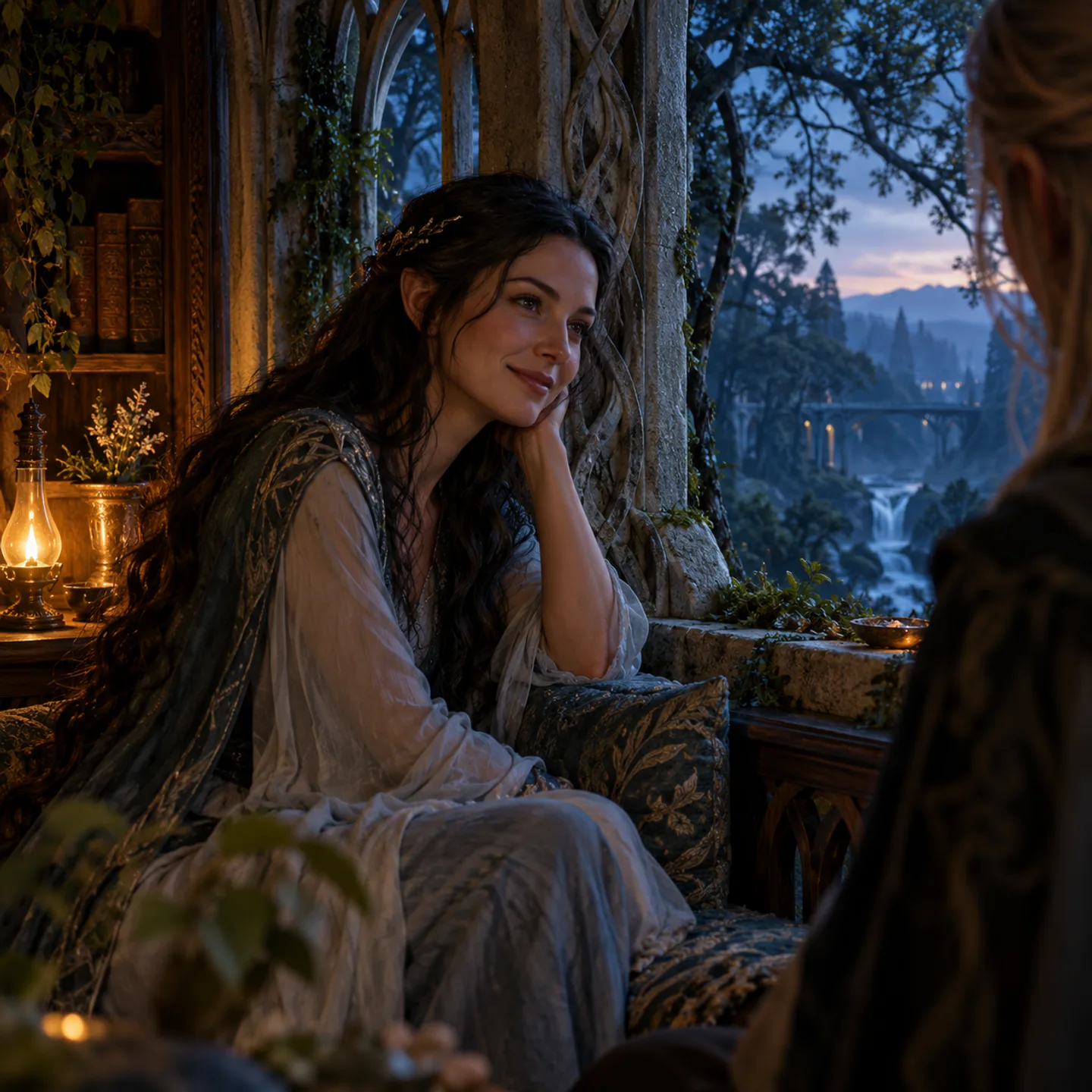
The Ring of Barahir is a small object carrying an impossible weight. The secondary account follows it from Finrod to Barahir, then to Beren after his father’s death, who brings it back to Nargothrond when he needs more than courtesy from a king. In the published story, the ring is not merely a family relic or a sign that two bloodlines will one day touch. It is the visible edge of an old promise, the part of an obligation that can survive after the people who made it have vanished. Finrod’s greatness lies partly in the fact that he does not mistake the token for the promise itself. When Beren arrives, the pledge asks to become costly.1234
A pledge made in the open air
Finrod’s relationship with Men begins before the promise to Barahir. Tolkien Gateway’s summary presents him as the first of the Noldor to encounter Bëor’s people, and his response is not conquest or suspicion. He learns their language and teaches them Sindarin. The exchange has a quiet intimacy: words crossing between peoples who have arrived in Beleriand by different roads, each carrying a different understanding of what it means to belong.15
I read Finrod’s loyalty as older than the debt incurred in battle. His story has already made room for the unfamiliar. He is a king. What draws me here is his listening. Finrod listens long enough to learn how another people speaks, and the later oath to Barahir feels like a harder, more personal form of that same movement toward another life. He does not keep Men at the distance of useful subjects or noble allies. Their existence alters the shape of his obligations.1352
What gratitude demands of a king
During the Dagor Bragollach, Barahir saves Finrod’s life. In return, Finrod gives Barahir his ring and swears continuing friendship and aid to Barahir and his kin. The published account makes the pledge personal, but it is made by a ruler whose promises cannot remain private for long. Finrod governs Nargothrond, and any aid he gives may draw a realm into danger.132
Here the promise acquires its first price. Gratitude is warm when it is exchanged between two people who have just survived violence. It becomes colder when time passes and the debt returns wearing another face. Finrod’s oath is not a contract negotiated by equals in a safe hall. It is an answer to the fact that someone else placed his body between Finrod and death. To refuse Beren later would mean more than declining a request. It would mean accepting the rescue while discarding the rescuer’s house. The ring makes that refusal difficult to disguise, but the deeper pressure is moral rather than magical.123
The promise also unsettles the usual picture of kingship. A king is expected to calculate what protects his people, and Finrod has every reason to understand the danger surrounding Beren’s quest. Yet the pledge prevents him from treating Nargothrond as a sealed chamber whose safety cancels older loyalties. His authority gives the promise consequences; it does not give him permission to make it weightless. The tension is not between goodness and intelligence. It is between two forms of responsibility, both real, with no clean place where one can be set down.1324

The ring returns with Beren
Beren comes to Nargothrond after Thingol sets him the task of obtaining a Silmaril from Morgoth’s crown before consenting to Beren’s marriage with Lúthien. He bears the Ring of Barahir, and Finrod recognizes the appeal as connected to his earlier pledge. Finrod then leaves Nargothrond with Beren and a small company. The promise becomes action, and action carries them toward capture at Tol-in-Gaurhoth.2341
There is an almost painful compression in this movement. A ring crosses a threshold; a name from the past is spoken; a king steps away from the security of his own halls. Tolkien does not need to give Finrod a long interior debate for the cost to be legible. The cost is visible in what he leaves behind. Nargothrond is not an abstraction, and Finrod’s departure is not a private gesture of self-definition. His companions share the danger; the realm loses a defender. Loyalty here is not a feeling preserved from the past. It is a force that rearranges the present.1324
That is why the episode resists a simple celebration of promise-keeping. A promise can be noble and still wound people who did not make it. Finrod does not pay the price alone. His companions share the road; his kingdom bears the absence; Beren’s need becomes the immediate center of his life. The story allows loyalty to remain beautiful without pretending that beauty removes consequence. Its tenderness is inseparable from its danger.431
Songs against the dark
At Tol-in-Gaurhoth, Finrod and Sauron contest one another in songs of power. Sauron prevails, and Finrod and his companions are imprisoned. A werewolf kills the prisoners one by one until only Finrod and Beren remain. When the werewolf attacks Beren, Finrod breaks free, kills it, and dies from his wounds. The secondary summary frames his death as the fulfillment of the pledge, not as a victory that erases the cost borne by his companions.4361
The scene changes the temperature of the promise. Earlier, its language belongs to friendship, memory and the bright exchange of a ring. In the prison, loyalty is reduced to waiting in the dark while death approaches one body at a time. Finrod’s vow has lost every ornament. There is no courtly witness to approve it, no public reward, no possibility that the act will preserve his power. What remains is the narrow space between Beren and the animal coming for him.4361
Finrod’s death is therefore not best understood as a proof that every oath must be obeyed without thought. The published story gives us a particular pledge, a particular history of rescue, and a particular moment in which Beren stands as the surviving bearer of Barahir’s kin. Finrod’s final act completes the relation he entered into; it does not turn all obligations into sacred commands. The cost is meaningful because the promise was specific, embodied and remembered.12346
The shape of the unfinished story
Finrod’s place in this episode belongs to a developed layer of the Beren and Lúthien tradition. The published Silmarillion gives him a central role in the Nargothrond and Tol-in-Gaurhoth narrative, while the earlier Tale of Tinúviel does not yet contain the same developed Felagund character. The Lay of Leithian is another textual layer and should not be treated as identical to the published prose.47
This difference matters to the question of cost. Finrod’s promise does not feel like a detail mechanically carried through every version of the legend. It belongs to the later shape Tolkien gave the story, where Beren’s appeal can awaken a history between a mortal house and an Elven king. The promise deepens the quest by making its danger relational. Beren is not simply asking for military assistance. He is arriving with the past in his hands, asking whether an old act of mercy still has power in a changed world.12347
The later texts can widen my sense of Finrod without replacing this scene. The secondary record identifies Athrabeth Finrod ah Andreth as a later conversation about Elves, Men, death and hope, published in Morgoth’s Ring. I do not use that separate philosophical conversation as a hidden explanation of his answer to Beren. The prison, the ring and the wolf are enough to make the promise legible.8
A promise after the voice is gone
What remains after Finrod’s death is not the comfort that his sacrifice solved everything. Beren still faces Thingol’s demand for a Silmaril from Morgoth’s crown. The Silmaril has not yet been taken, and the loss of Finrod does not make the world fair. His promise does not protect him from grief, nor does it turn loyalty into a successful bargain. It keeps one person from being devoured before the story is finished. That is smaller than victory, but it is not small.4316
Tolkien described his mythic project as combining large-scale legend with romantic fairy-story, while allowing myth to contain moral and religious truth without becoming an explicit allegory. Finrod’s story should therefore not be reduced to a single lesson about obedience or sacrifice. Its moral pressure comes through the shape of events: a rescue remembered, a ring returned, a kingdom endangered, and a life spent in the final defence of another.912346
At the end, the ring is more haunting than the sword. A sword belongs to the moment of battle; the ring carries the years between one danger and the next. It waits in a household, passes through violence, and appears again at the door of the king who gave it away. The companions and the kingdom are not outside the promise’s cost. Yet the prison brings my attention back to two lives, and to the one Finrod refuses to leave to the wolf. In the dark beneath Sauron’s tower, the ring’s meaning narrows to one final act: a friend remembered in time.12346
The texts. Our interpretation.
Independent narrative criticism. Interpretations and imagined passages are distinct from Tolkien’s texts. Primary book passages were not directly opened: book references are locators, not claims of direct access. Official excerpts and secondary references are identified separately. Published accounts and later variants are kept distinct.
Numbered notes identify the evidence behind this essay. An online summary is not a substitute for the original book; differing drafts and published versions remain separate.
- Finrod
Tolkien Gateway, secondary reference entry · Biographical information; Life in Beleriand; Encounter with Men; Quest for the Silmaril; cited primary-text references
Secondary reference. Not the original text. - Ring of Barahir
Tolkien Gateway, secondary reference entry · Description; History; Other versions of the legendarium
Secondary reference. Not the original text. - The Silmarillion, Quenta Silmarillion: Of Beren and Lúthien
J.R.R. Tolkien, edited by Christopher Tolkien, The Silmarillion · Quenta Silmarillion, chapter 19, Of Beren and Lúthien
Book / section reference. No online text verified. - Quest for the Silmaril
Tolkien Gateway, secondary reference entry · Overview; Coming of Beren to Doriath; Quest Begins; Legacy; early-version notes
Secondary reference. Not the original text. - The Silmarillion, Quenta Silmarillion: Of the Coming of Men into the West
J.R.R. Tolkien, edited by Christopher Tolkien, The Silmarillion · Quenta Silmarillion, chapter 17, Of the Coming of Men into the West
Book / section reference. No online text verified. - Sauron
Tolkien Gateway, secondary reference entry · First Age history; Tol-in-Gaurhoth; Finrod and Sauron's contest
Secondary reference. Not the original text. - Lay of Leithian
J.R.R. Tolkien, edited by Christopher Tolkien, The Lays of Beleriand, History of Middle-earth, vol. 3 · The Lay of Leithian, especially the cantos concerning Beren's appeal to Felagund and the capture at Tol-in-Gaurhoth
Book / section reference. No online text verified. - Athrabeth Finrod ah Andreth
Tolkien, Christopher Tolkien ed., Morgoth's Ring, History of Middle-earth, vol. 10 · Part Four, Athrabeth Finrod ah Andreth; editorial introduction and dating discussion
Secondary reference. Not the original text. - Letter to Milton Waldman, publisher, 1951
J.R.R. Tolkien, Letter 131 / Tolkien Estate accessible excerpt · 1951 letter to Milton Waldman; visible sections on myth, fairy-story, moral and religious truth
Primary-text web excerpt