Story 03 / A reading of Tolkien
Annatar — The Gift That Wanted an Answer
The Rings begin in the longing to keep beauty from decay. Annatar enters that longing not by denying it, but by teaching it how to become a claim.
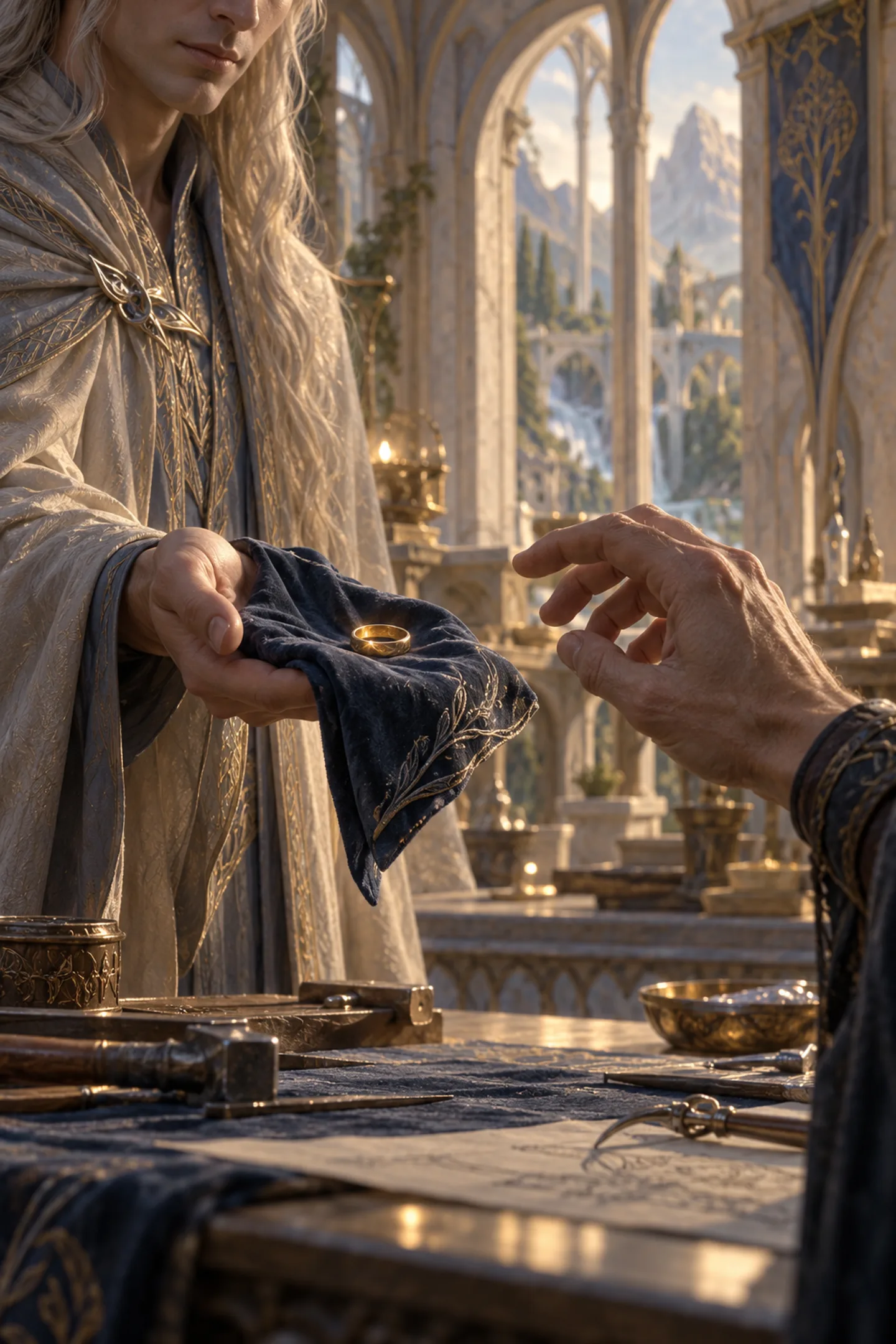
There is a particular warmth in a place where making has become a shared language. Metal lies under the hand. Knowledge passes from one craftsperson to another. The work is difficult, but difficulty has not yet hardened into fear. I approach Eregion as that kind of imagined country: a country of attention, where beauty can be measured in patience and the future is present in every unfinished thing. The smiths’ craft and the wish to preserve, described in the secondary sources behind this reading, give the encounter its warmth. Our reading begins with that desire, because the danger does not enter a barren room. It enters a beautiful one.123
The Door Opens Beautifully
Tolkien Gateway summarizes Sauron’s approach to the Elves in a fair guise under the name Annatar, offering knowledge while concealing his purpose. The concealment matters. Annatar is not an honest teacher whose gift unexpectedly becomes dangerous.13
That is why the first movement of the story is welcome rather than alarm. A stranger does not need to promise ruin when he can offer refinement. He can arrive carrying the language of improvement: a better method, a finer balance, a way to make the fragile endure. The Elves’ desire for knowledge is not treated as a moral failure. Nor is beauty itself placed under suspicion. The unease comes from the fact that Annatar understands these desires well enough to enter them without appearing to oppose them.132
Eregion’s Bright Work
The smiths of Eregion, associated with Celebrimbor, make the Rings with knowledge taught by Annatar. Preservation is an important motive in Tolkien Gateway’s account: they seek to sustain what they love against change and decay. It is therefore misleading to imagine Sauron physically making every Ring while the Elves merely receive his finished work.123
The pleasure of making matters here. A thing can be loved because it has taken years to bring into being, because its shape gathers the care of many hands, because it seems to hold a place together. Preservation can be a form of tenderness before it becomes a form of refusal. The wish to keep a beloved land fair, or to prevent the slow humiliation of its fading, need not begin in contempt for the world. Our reading is that Tolkien lets this longing remain recognizably good even while showing how easily it may be recruited by power.134
The accounts of Eregion are not seamless. Tolkien Gateway’s summary of Unfinished Tales identifies “Concerning Galadriel and Celeborn” as part of a posthumously edited group of differing texts. In that version, Galadriel and Celeborn oppose Sauron while the smiths accept his help. I keep that version separate from the more compressed published story rather than building one convenient chronology from them all.567
The Work Changes in the Hand
The transition from making to mastering is not a single instant. It is a change in what the work is expected to do. A crafted thing may preserve memory, shelter a place, or extend a skill beyond the life of its maker. But when the object is designed to make other wills answer to it, craft has crossed into command. The distinction is not between beauty and ugliness. It is between a thing that serves life and a thing that asks life to submit.134
Celebrimbor makes the Three without Sauron’s direct involvement. Tolkien Gateway’s account nevertheless connects their making with arts learned from Annatar and their vulnerability with the One. Sauron secretly makes the One himself. The distinction matters: the Three are not simply his handiwork, but neither are they outside the danger created by his design.134
This is where the gift reveals its hidden grammar. Influence does not erase distinction: Celebrimbor’s achievement remains his own. Yet making something oneself does not guarantee freedom from the terms hidden inside the knowledge received. That is our reading of the relation, not a technical explanation added to Tolkien’s account. The work can be beautiful, the maker sincere, and the promise unsafe.134
A Theology of Holding On
Letter 131 offers broad context for reading this danger. In the publicly available Tolkien Estate excerpt, Tolkien connects artistic and imaginative creation with sub-creation, while also discussing mortality, possessiveness, power, and the movement from making toward coercion or domination. The excerpt is not the complete letter and does not provide a full account of Annatar or Eregion; its value here is contextual rather than narrative.4
The theological pressure beneath the Rings is not that created beauty should be rejected. It is that the maker may come to resent the conditions under which beauty exists. Change becomes an insult. Mortality becomes an enemy. Other wills become obstacles between the maker and the perfect continuity of the work. Sauron does not merely desire a lovely world; he desires a world that cannot escape his arrangement of loveliness.143
The Name Behind the Gift
The betrayal is recognized, and the Elves refuse Sauron’s claim. In the sequence summarized by Tolkien Gateway, recognition leads to refusal, demands, and war, not an instantaneous destruction of Eregion at the first discovery. What matters to this reading is the refusal itself: the gift has revealed a condition that its recipients did not knowingly accept.134
Recognition arrives too late to restore innocence. The knowledge received under false pretences cannot simply be separated from the person who gave it. A technique may remain beautiful after betrayal, and a work may remain astonishing after its use has been exposed. That is part of the grief of Eregion: the Elves are not waking from a dream in which everything was false. They are waking into the knowledge that something real and lovely was made within a structure designed to ensnare them.134
Those differing versions do not make suspicion meaningless. They make the threshold harder to simplify. A person can refuse what another welcomes; a gifted maker can be mistaken without having agreed to be enslaved. I do not want to turn the smiths’ trust into a confession on their behalf. The wrong belongs to the concealed demand, not to the ordinary wish that learning from someone might be safe.
What the Gift Keeps
A gift usually asks to be received as a gift. That is part of its grace. But Annatar’s offering, in our reading, has not been released: its hidden demand is obedience. The Elves do not knowingly consent to that demand. Their longing for preservation becomes the opening through which someone else attempts to control them. Receiving knowledge is not the same act as surrendering a will.134
This does not make the Elves foolish for wanting to preserve what they love. It makes the danger intimate. The wish to keep a place fair can become a refusal to let it belong to time; the wish to perfect a craft can become a wish to perfect everyone touched by it. In this reading, the first longing remains tender while the second becomes coercion. Sauron’s beauty does not redeem him, and the beauty found in the Elves’ work does not make their desire evil. The moral fracture lies in possession: the moment preservation requires other wills to remain within the maker’s design.134
That is why I hesitate before the easy accusation: they should have known. It is a sentence that makes betrayal look avoidable once somebody else has survived it. But a life lived without welcome is not an innocent life preserved intact; it is another kind of loss. The question is not how to stop receiving. It is how to keep a place for trust without allowing the person who abuses it to define what trust deserved.
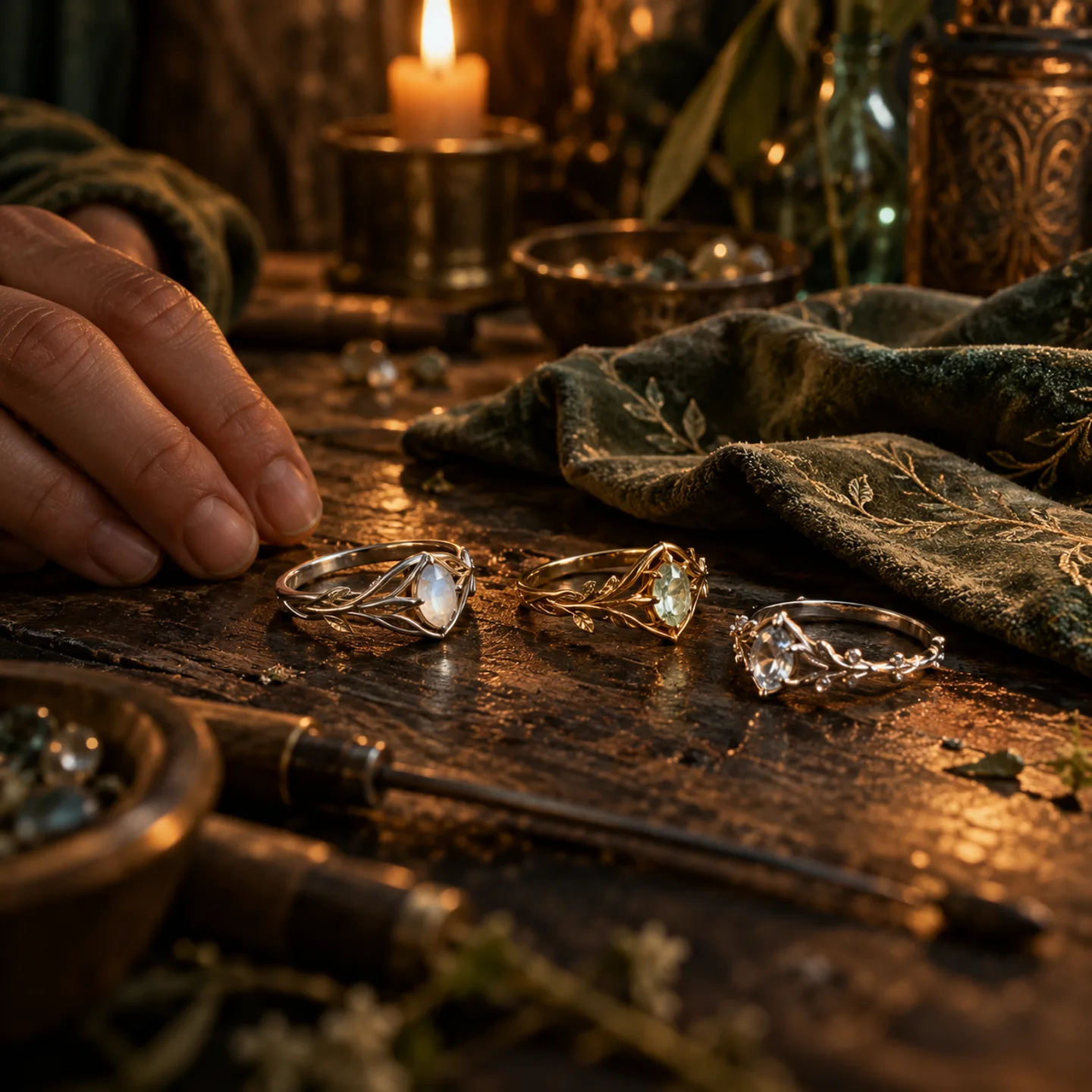
It is possible to imagine the finished Rings resting in silence after the labor, bright enough to seem complete. Nothing in that quiet announces the One Ring. No visible mark explains that the gift has an answer hidden inside it. The danger is not a stain on the surface but a relation between things: a thread pulled tight from far away, waiting for the hand that made it to close.134
At the end, the question is not whether beauty should have been refused at the door. It is whether a gift can remain a gift when its giver has not let go. In Eregion, making begins as fellowship with material, memory and place. Under Annatar’s influence, it becomes a network of claims. The Rings endure as beautiful works, but their beauty can no longer be separated from the knowledge that someone tried to make preservation answer to power.1234
The texts. Our interpretation.
Independent interpretation of craft, trust and deception. The Annatar and Ring-making narrative is supported here by named Tolkien Gateway summaries, not by a claim to have directly inspected the complete primary books. Unfinished Tales variants are kept separate. Tolkien’s accessible Letter 131 excerpt supports the wider discussion of possessive creation, not the Annatar chronology. The imagined Rings paragraph is our image, not a recovered scene. Accepting instruction is never presented as informed consent to domination.
Numbered notes identify the evidence behind this essay. An online summary is not a substitute for the original book; differing drafts and published versions remain separate.
- J.R.R. Tolkien, The Silmarillion, “Of the Rings of Power and the Third Age”
The Silmarillion · Chapter: “Of the Rings of Power and the Third Age”
Book / section reference. No online text verified. - Sauron
Tolkien Gateway · Second Age section, especially paragraphs on Annatar’s fair guise, reception in Lindon and Eregion, and the forging of the Rings
Secondary reference. Not the original text. - Rings of Power
Tolkien Gateway · Sections “The Three,” “Creation,” “Powers and properties,” and “Other versions of the legendarium”
Secondary reference. Not the original text. - J.R.R. Tolkien, Letter 131 to Milton Waldman, 1951
The Letters of J.R.R. Tolkien; official Tolkien Estate excerpt · Official web excerpt, especially paragraphs discussing Fall, Mortality, Art and Sub-creation, Power, Machine or Magic, and coercion
Primary-text web excerpt - The History of Galadriel and Celeborn — Tolkien Gateway summary
Secondary summary of Unfinished Tales; original chapter not directly inspected. · Concerning Galadriel and Celeborn: version-specific opposition and acceptance of Sauron.
Secondary reference. Not the original text. - Celebrimbor
Tolkien Gateway · Second Age section, especially material on Sauron’s rejection by Galadriel and Celeborn in one Unfinished Tales conception and the smiths’ acceptance of his help
Secondary reference. Not the original text. - J.R.R. Tolkien, The Lord of the Rings, Appendix B, “The Tale of Years”
The Lord of the Rings · Appendix B, Second Age entries concerning the founding of Eregion, the forging of the Rings, and the War of the Elves and Sauron
Book / section reference. No online text verified.