Story 14 / A reading of Tolkien
Beren and Lúthien — Love and the Price
In the published Silmarillion, love does not remove the cost of an oath. It changes who is willing to pay, and what kind of future remains possible afterward.
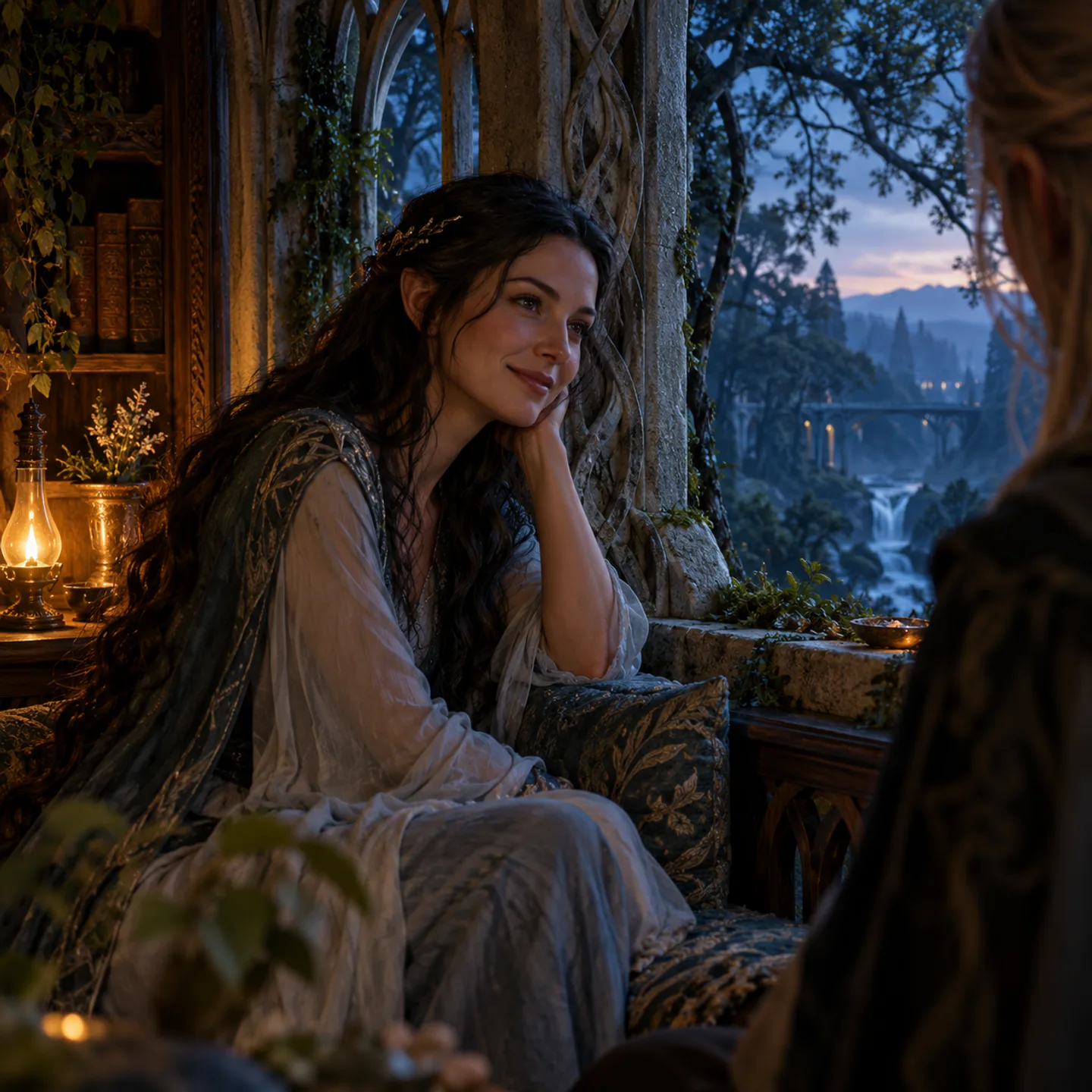
In the secondary account of the published story, love is made to stand beside an impossible object: a Silmaril cut from Morgoth’s crown. Thingol’s demand turns marriage into a bargain with the shape of a death sentence. Beren must bring back what no ordinary hand could take, and Lúthien’s future is placed behind the condition. Yet the tale does not leave love waiting at the end of a quest, polished and passive, as though it were a reward. Again and again, the promised future is interrupted by the people who are supposed to earn it. For now, I want to stay at that doorway: a father’s demand, and two lives he cannot decide for.1234
The version held in the hand
This essay follows secondary summaries of the published Silmarillion version, chiefly chapter 19, Of Beren and Lúthien. That choice matters. The story exists in several forms: the early Tale of Tinúviel, the unfinished Lay of Leithian, later Quenta materials, and the posthumously edited narrative published in 1977. They are related, but they are not one seamless account waiting to be harmonised.23456789
The published chapter has a particular pressure. It gives us Beren as a mortal Man and Lúthien as an Elf-maiden of royal lineage, so their love crosses not only a family boundary but two different destinies. That difference is not decorative. It makes every promise unstable. To love is already to approach a life neither can simply inherit from the other.1234
The earliest surviving form differs substantially from this later arrangement. In the secondary account of the early tale, Beren is Elvish, and figures and places central to the published story, including Finrod Felagund and Nargothrond, are absent. The Lay of Leithian is another layer again: an unfinished verse narrative, not a complete alternative edition of the prose tale.56789
So the question here belongs specifically to the published chapter. What does love have to do with the price of the promise when the story refuses to make either lover a simple instrument of the other’s desire? What catches me is the moment consent changes who is allowed to decide.34
A father’s condition
Thingol sets the condition plainly: Beren must bring him a Silmaril from Morgoth’s crown before he may marry Lúthien. The demand is impossible in practical terms and intimate in its cruelty. Thingol does not send Beren toward an abstract treasure. He sends him toward the heart of the enemy’s power, making the proposed marriage answerable to an object already entangled in the wars of the world.34
For me, the condition exposes the limits of parental authority. Beren can accept the ordeal, but Lúthien is not thereby a prize waiting behind it. Thingol’s test tries to reduce love to proof; that proof has a body, a will, and consequences for more than one person.34
This is where the story’s tenderness becomes severe. Beren’s promise is not a soft pledge sheltered from history. It is made under pressure, and the pressure is partly created by the beloved’s household. The romance therefore begins with an uncomfortable question of agency: if one person undertakes the danger, can the other remain outside the decision? Lúthien’s later actions answer by refusing that arrangement, though they do not erase the harm that made it necessary.34
The beloved who crosses the threshold
The secondary synopsis follows Lúthien out of Doriath, through captivity and Huan’s aid, to Sauron’s defeat at Tol-in-Gaurhoth and her reunion with Beren. I do not read her as a reward left waiting behind the quest. Later, she enters Angband with him. Her actions are not a single gesture of rescue appended to Beren’s quest; they form a second movement of the tale, with its own dangers and decisions.34
The difference is felt in the story’s changing centre of gravity. At first, Beren seems to be the one who must act so that love can become possible. Then Lúthien moves through the barriers that have been built around him. She does not merely follow the road he has taken. She changes the conditions under which the road can continue. The promise becomes shared not because the danger has become equal in some measurable way, but because neither lover accepts a future in which the other’s will can be replaced by an arrangement made elsewhere.34
There is no need to turn Lúthien into a modern emblem in order to notice this. The published tale is shaped by a theological and hierarchical world, one in which lineage, fate, mortality, and inherited power matter deeply. Within that world, her agency is startling precisely because it is not granted by a change of genre. She remains bound to the world’s costs. Her courage does not make her invulnerable, and her love does not make Beren’s suffering symbolic rather than physical.1234
The Silmaril and the wound
Beren and Lúthien enter Angband together. Lúthien’s power puts Morgoth and his court into sleep, and Beren cuts a Silmaril from the crown before the knife Angrist breaks. Their success is astonishing, but the tale does not present it as a clean triumph. Carcharoth bites off Beren’s hand and swallows the jewel. Beren later bears the name Erchamion, the One-handed.34
The physical detail resists the temptation to treat the Silmaril as a floating symbol of love. It is a jewel, but it is also weight, edge, possession, and wound. The promise has been fulfilled in the narrowest possible sense, and the fulfilment has marked Beren permanently. The hand that reached for the object is gone. A condition designed to make marriage impossible has been answered, but not defeated without leaving its signature on the body.34
This is why the story’s price cannot be understood as a fee paid once. Thingol asks for the jewel as though the cost could be contained in a single task. The narrative expands the cost outward: into Beren’s injury, into the danger carried by the Silmaril, and into the grief that follows victory. Love has not purchased a private sanctuary from history. It has entered history more deeply.3412
Still, the wound is not proof that the promise was foolish. Nor is it proof that suffering ennobles the lovers by itself. The story is more exacting than either conclusion. Beren’s loss matters because the promise was made between persons, not because pain automatically makes an oath sacred. The value lies in the continued recognition between them after the heroic image has been damaged.1234
After the quest has ended
The successful return does not close the tale. The secondary synopsis describes Beren dying during the Hunting of the Wolf and Lúthien choosing mortal life with him. This is not a promise that Valinor grants immortality to mortals, nor is it a simple restoration of what the quest destroyed.34
The choice changes the emotional temperature of the story. The earlier dangers are loud: captivity, pursuit, the sleeping court of Angband, the bite that takes Beren’s hand. Afterward, the central act is quieter and more terrible. Lúthien must decide what kind of existence she wants when the adventure has already proved its cost. The question is no longer whether she will help Beren enter danger. It is whether she will accept a future defined by survival without him.34
Her decision is often flattened into the language of romantic permanence, but permanence is not what the story offers. It offers mortality chosen with open eyes. Lúthien does not rescue Beren from the order of the world; she joins him within a diminished and finite life. The tenderness lies partly in that refusal of false escape. Their love does not abolish death. It becomes meaningful at the point where death cannot be bargained away.1234
What the promise changes
Tolkien later described Beren and Lúthien as central to the larger mythology and as an example of seemingly small or obscure figures affecting the great movements of history. In the published narrative, their actions do in fact carry consequences beyond the private terms of Thingol’s demand: the Silmaril leaves Morgoth’s crown and enters a history neither lover can keep private.2341
But the importance of Beren and Lúthien does not depend on making them secretly more powerful than they appear. Their influence begins in a stubbornly local place: a father’s refusal, a lover’s promise, a woman who will not remain behind the terms set for her, and a hand lost to an object no one can safely own. The great movements of history pass through these intimate decisions without making them less intimate.3412
The price, then, is not simply the Silmaril, the hand, or the deaths that follow. For me, it is the loss of the fantasy that love can preserve both people unchanged. Beren and Lúthien do not arrive at a perfect future. They arrive altered, wounded, and mortal. They keep choosing one another. The original promise has become larger and darker than either of them could have known.1234
At the end, the jewel is no longer only the object Thingol demanded. It has passed through sleep, steel, blood, grief, and the hands of those who could not keep their lives separate from the world’s violence. The story leaves it shining, but not clean. Beside it stands the more difficult image: Lúthien choosing a finite life, and Beren bearing the shape of what love has cost him. The promise has not saved them from the world. It has given the world another way to remember them.3412
The texts. Our interpretation.
Independent narrative criticism. Interpretations and imagined passages are distinct from Tolkien’s texts. Primary book passages were not directly opened: book references are locators, not claims of direct access. Official excerpts and secondary references are identified separately. Published accounts and later variants are kept distinct. Reading notes: After the quest has ended — I keep the account of that choice broad rather than reconstruct every step in the passage through Mandos and return.
Numbered notes identify the evidence behind this essay. An online summary is not a substitute for the original book; differing drafts and published versions remain separate.
- J.R.R. Tolkien, Letter to Milton Waldman, publisher, 1951
Letter to Milton Waldman · 1951 letter; Tolkien Estate accessible transcription
Primary-text web excerpt - Catherine McIlwaine, Beren and Lúthien
Tolkien Estate essay · Web essay, lines introducing The Silmarillion chapter and the Waldman letter
Secondary reference. Not the original text. - J.R.R. Tolkien, The Silmarillion, edited by Christopher Tolkien
The Silmarillion · Quenta Silmarillion, chapter 19, Of Beren and Lúthien; chapter 24, Of the Voyage of Eärendil and the War of Wrath
Book / section reference. No online text verified. - Tolkien Gateway, Of Beren and Lúthien
Secondary reference entry · Synopsis and development sections, especially lines concerning Thingol's demand, Lúthien's rescue of Beren, the Angband episode, the wolf-hunt, and the choice after death
Secondary reference. Not the original text. - J.R.R. Tolkien and Christopher Tolkien, Beren and Lúthien
Beren and Lúthien · Christopher Tolkien's introductory material and arranged textual sequence: The Tale of Tinúviel; Sketch of the Mythology; The Lay of Leithian; Quenta Silmarillion materials; The Silmarillion ending
Book / section reference. No online text verified. - J.R.R. Tolkien and Christopher Tolkien, The Lays of Beleriand
The History of Middle-earth, volume 3 · Chapter 3, The Lay of Leithian; chapter 4, The Lay of Leithian Recommenced
Book / section reference. No online text verified. - David Bratman, The History of Middle-earth
The Tolkien Estate essay on The History of Middle-earth · Sections on The Book of Lost Tales, The Lays of Beleriand, later Silmarillion revisions, and Christopher Tolkien's editorial work
Secondary reference. Not the original text. - Tolkien Gateway, Beren and Lúthien
Secondary reference entry for the 2017 compilation · Synopsis, contents, and development sections
Secondary reference. Not the original text. - Tolkien Estate, Selected further reading
Tolkien Estate reference essay · Sections distinguishing The Silmarillion, the broader Silmarillion materials, and History of Middle-earth
Secondary reference. Not the original text.