Story 15 / A reading of Tolkien
Fingolfin — When Victory Is Gone
After the breaking of the siege, Fingolfin rides alone. What can courage still mean when it cannot undo the loss?
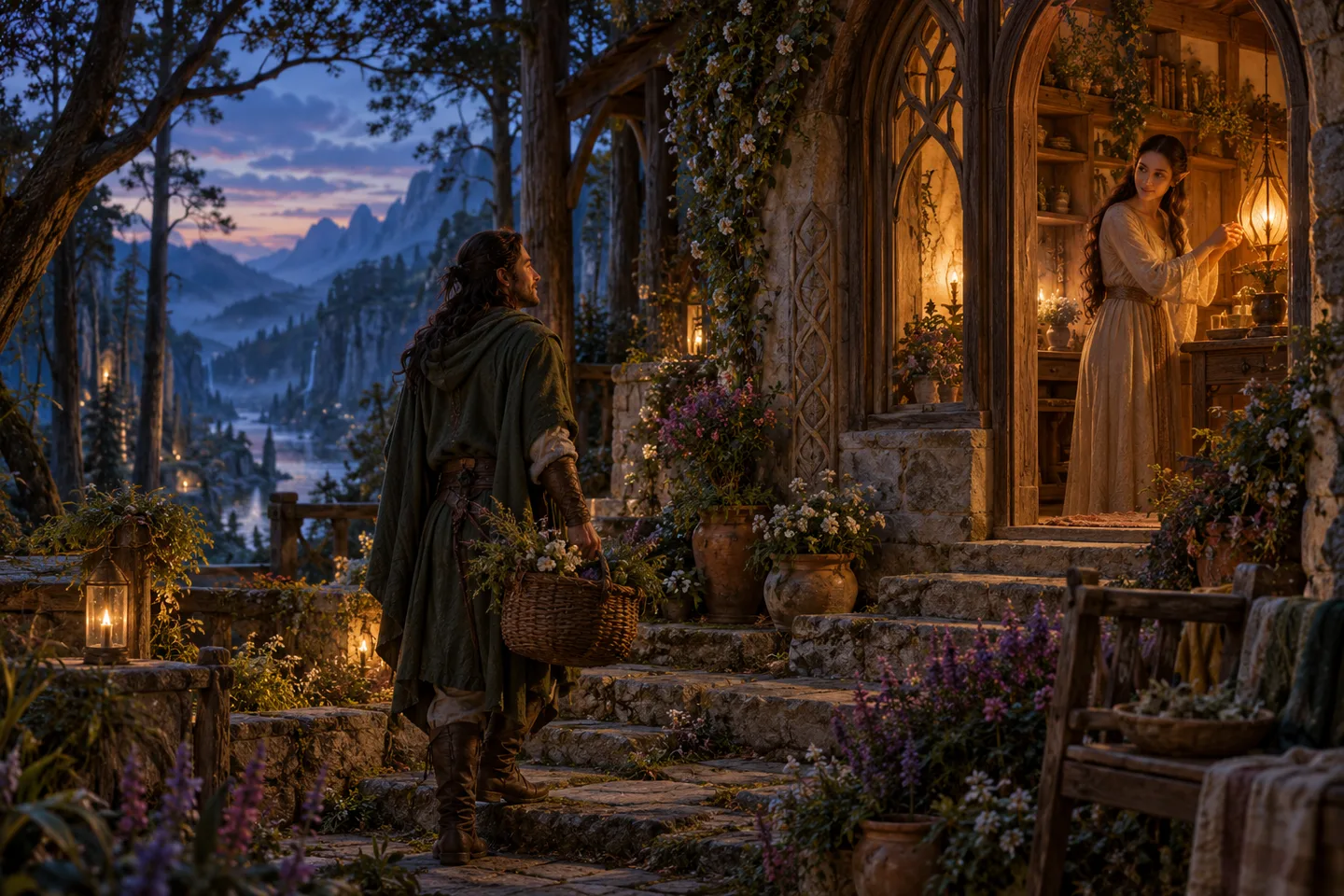
After a kingdom has been broken, a different silence settles over it. It is not peace. The hills remain, the roads remain, the names of the dead remain, but the future has lost its ordinary shape. Tolkien Gateway’s summary of the published Silmarillion places Fingolfin’s solitary ride after the Dagor Bragollach, from Hithlum toward Angband. The silence around that ride is my reading of the loss, not a detail recovered from the chapter. The gesture is magnificent, but magnificence is not the same as triumph. His ride begins in the narrow country between courage and despair, where a promise may still be alive even after the world that gave it meaning has gone.1234
The king after the breaking
The published genealogy, as discussed by Megan N. Fontenot, makes Fingolfin a son of Finwë and Indis, and Fëanor’s younger half-brother. He belongs, therefore, to a family already strained by inheritance, pride and divided loyalty, but chapter 18 does not pause to offer a complete psychological account of the man who leaves Hithlum. It gives us the aftermath first: the forces of Morgoth have broken through, the land is exposed, and Fingolfin rides alone across the ruined plain toward Angband.3512
The loneliness matters more than the speed of the ride. A king can be surrounded by banners and still arrive at the end of public language. Commands have failed; walls have failed; the great expectation that the Noldor might contain their enemy has failed. Fingolfin’s solitude is not the solitude of a romantic hero untouched by obligation. It is the solitude of someone who carries the obligations of many people into a place where no ordinary answer remains. His fury may be grief given a direction. His despair may be the knowledge that direction itself cannot restore what has been lost. The text leaves those motives in tension, and its restraint is part of the tragedy.12356
Promises do not make the road safe
The published chapter records Fingolfin’s challenge to Morgoth, but it does not provide a single settled diagnosis of why he makes it. Later materials discussed by Megan N. Fontenot develop a reconciliation between Fingolfin and Fëanor and associate Fingolfin with a vow to follow his elder brother. Those elements belong to a later textual layer, associated in Fontenot’s discussion with material from Morgoth’s Ring, and they should not be folded invisibly into the published narrative as though every version were one continuous biography.123578
Yet the later material changes the pressure around the scene, even when it cannot be used as a simple explanation. A promise is often imagined as a bright thing: a thread held through darkness, a proof that the self has not abandoned its word. But promises also outlive the circumstances that made them bearable. They can become heavy when the beloved country is burning, when a promise survives the person to whom it was made, or when the promised future has narrowed to one final act. Fingolfin’s ride can be read through that burden without reducing it to obedience. The later vow invites a question about what an old promise costs. It does not establish that Fingolfin thinks of Fëanor on this ride. The point is not to choose one motive and seal the others outside the door. The point is that courage here has become crowded with debts.574
The door of Angband
In the secondary summaries of the published encounter, Morgoth comes out to meet Fingolfin rather than bear the shame of refusing before his captains. The encounter is not a balanced contest between two equal kings. Fingolfin confronts the enemy whose assault has broken the siege. I read the encounter as terribly unequal, not as a contest between matching powers. The terms of the meeting are already cruel before the first blow is struck.123
This is where fury becomes strangely lucid. Fingolfin cannot win in the broad sense. He cannot return the dead or make the preceding losses unhappen. But he can deny Morgoth the ease of total victory. That denial is smaller than salvation and more meaningful than spectacle. It refuses to let power define the whole shape of the world. An Elf stands before a power accustomed to obedience. The resistance here is his; it need not be made to represent every theme in Tolkien’s mythology.123
The distinction matters because defiance can be beautiful without being innocent. Fingolfin does not escape the consequences of his decision. He does not save himself by discovering that courage was secretly a form of invulnerability. The challenge is an act of resistance, but it is also an act that spends the last reserve of a king whose people have already paid heavily. That double edge keeps the scene from becoming a lesson in bravery. It remains an argument with defeat, conducted in a language defeat can understand: the body placed before the weapon.1234
Seven wounds and no victory
The summaries count seven wounds inflicted with Ringil during the duel. He evades repeated blows from Grond, but the hammer breaks the ground into pits, and exhaustion eventually leaves him caught in one of them. His final stroke wounds Morgoth’s foot. The secondary account reports lasting consequences for Morgoth: he bears a limp and enduring wounds after the encounter, even though Fingolfin himself is killed.123
There is no clean arithmetic here. Seven wounds do not add up to victory, and death does not erase what the sword achieved. Fingolfin’s body is overcome, but Morgoth’s body is altered. The tyrant survives with damage that cannot be hidden from those who serve him. The result is neither consolation nor defeat alone. It is a torn piece of agency, held briefly in the hand of someone who cannot keep it. Fingolfin does not make the enemy harmless. He makes him carry evidence of resistance.123
That distinction gives the duel its unusual emotional temperature. At first there is heat: anger, movement, the bright insistence of steel. Then the scene lowers into fatigue. Grond has made hollows in the earth; the body that crossed the plain is no longer an instrument of will but something caught, breathing, failing. The grandeur drains away without becoming meaningless. Tolkien allows courage to remain real after its practical usefulness has nearly disappeared. This is perhaps the hardest form of courage to look at, because it offers no promise that endurance will be rewarded with survival.123
What the living inherit
Tolkien Gateway reports that, after Fingolfin’s death, Thorondor rescues the body from Morgoth. Turgon builds a cairn over Fingolfin’s remains, and Fingon succeeds him as High King of the Noldor. Fontenot reports the published account’s silence: Fingolfin’s people do not make a song about his death. An unfinished poetic treatment of the episode appears in The Lay of Leithian, but that work belongs to a different and incomplete textual setting.12356
The cairn is quieter than the duel, and therefore more devastating. A cairn does not reverse a death. It gives the dead a place in a landscape that has become difficult to inhabit. The body is rescued from Morgoth, but the people do not receive their king back. They receive a mound, a boundary, a location toward which grief can travel without finding an answer. Even the absence of a song feels less like silence chosen for effect than silence made necessary by the scale of the loss.12356
There is no victory his people can simply live inside. Fingolfin has wounded Morgoth, but his people remain bereaved. The enemy has suffered, but the kingdom has not been restored. A successor takes the crown, yet succession is not repair. What survives is not a triumphant meaning waiting to be extracted from the death. What survives is the duty to continue among the damaged: to remember the king, to protect the living, and to carry forward a promise whose price has become visible.12356
The road that remains
It is tempting to make Fingolfin’s last ride either noble beyond criticism or irrational beyond respect. Both judgments are too small. The published narrative gives us fury and despair without converting them into a clinical explanation, while the later texts complicate the emotional inheritance without becoming a seamless key to the scene. I feel the pressure of old promises here. Grief and duty may have become indistinguishable. One word cannot hold the man.123578
At the end, there is no victory waiting behind the hill. There is only the scarred foot of Morgoth, the empty ground where Ringil has passed, and, later, a cairn holding the shape of a king whom the living cannot turn into a song. The road does not lead back to the world Fingolfin meant to defend. It leads toward the burden of those who remain, carrying grief without pretending it is triumph.12356
The texts. Our interpretation.
Independent narrative criticism. Interpretations and imagined passages are distinct from Tolkien’s texts. Primary book passages were not directly opened: book references are locators, not claims of direct access. Official excerpts and secondary references are identified separately. Published accounts and later variants are kept distinct.
Numbered notes identify the evidence behind this essay. An online summary is not a substitute for the original book; differing drafts and published versions remain separate.
- Tolkien Gateway, Fall of Fingolfin
The Silmarillion, Quenta Silmarillion, chapter 18: “Of the Ruin of Beleriand and the Fall of Fingolfin” · Page sections headed “Event Information” and paragraphs describing the challenge, duel, death, rescue, and cairn; retrieved page last modified January 26, 2025.
Secondary reference. Not the original text. - Tolkien Gateway, Of the Ruin of Beleriand and the Fall of Fingolfin
The Silmarillion, Quenta Silmarillion, chapter 18 · Page sections covering the Dagor Bragollach, Fingolfin’s ride, the duel, Morgoth’s wounds, Thorondor, Turgon, and Fingon.
Secondary reference. Not the original text. - J.R.R. Tolkien, The Silmarillion
The Silmarillion · Quenta Silmarillion, chapter 5 “Of Eldamar and the Princes of the Eldalië”; chapter 9 “Of the Flight of the Noldor”; chapter 13 “Of the Return of the Noldor”; chapter 18 “Of the Ruin of Beleriand and the Fall of Fingolfin.”
Book / section reference. No online text verified. - J.R.R. Tolkien, Letter to Milton Waldman, publisher, 1951
Letter to Milton Waldman, 1951 · Accessible Tolkien Estate excerpt; paragraphs on myth, Fall, Mortality, the Machine, coercion, and the relation between large and lesser tales.
Primary-text web excerpt - Megan N. Fontenot, Exploring the People of Middle-earth: Fingolfin, High King of the Noldor
Fingolfin textual history and character study · Paragraphs 104–110, 137–155, and 167–173.
Secondary reference. Not the original text. - J.R.R. Tolkien, The Lays of Beleriand, edited by Christopher Tolkien
The Lays of Beleriand · “The Lay of Leithian,” Canto XII; commentary and textual apparatus surrounding the unfinished account of Fingolfin’s challenge.
Book / section reference. No online text verified. - J.R.R. Tolkien, Morgoth’s Ring, edited by Christopher Tolkien
Morgoth’s Ring · The Later Quenta Silmarillion; material concerning the reconciliation of Fingolfin and Fëanor, Fingolfin’s vow, and the development of the Noldorin family history.
Book / section reference. No online text verified. - David Bratman, The History of Middle-earth
The History of Middle-earth · Tolkien Estate contextual essay, especially paragraphs 72–76 and 91–94.
Secondary reference. Not the original text.