Story 01 / A reading of Tolkien
Sauron — Before the Eye
A maker’s delight. A tyrant’s certainty. The frightening distance between wanting a world to flourish and refusing to let it choose.
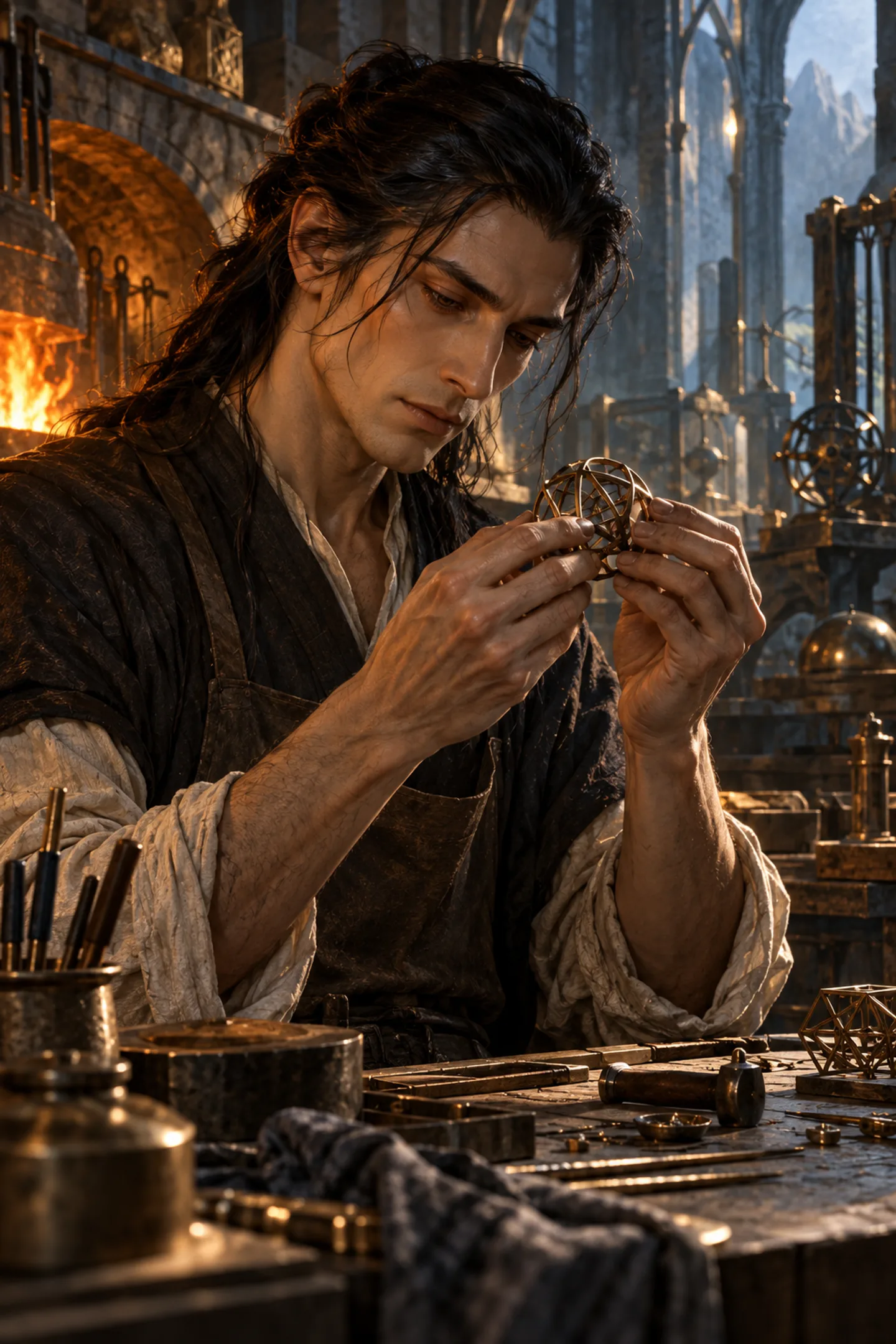
Before he wanted to rule the world, he wanted to make it beautiful. That is our opening thought, not a quotation from Tolkien or a fixed chronology of Sauron’s desires. Beauty, in this reading, is not softness. It is the clean edge of a plan, the pleasure of parts fitting together, the world made legible beneath a steady hand. Somewhere inside that pleasure lies the first chill. A thing may be shaped because it is loved, or because its maker cannot bear that it should remain beyond his control.
A spirit before a biography
Sauron is a Maia, not a mortal or an Elf grown into a god. Tolkien Gateway’s summaries of the Maiar and Valaquenta place him among spirits whose existence precedes the histories of Elves and Men. That distinction changes the scale of the story without explaining away its choices. A great power can still take a ruinous road.12
The Valaquenta summary places Sauron among the spirits drawn into Melkor’s service. What it does not give us is the private conversation we might wish to hear: the pause, the hesitation, the moment before allegiance becomes habit. No invented conversation can fill that silence honestly. The silence is part of the encounter. We can look toward an origin without pretending that a surviving text has opened every door.1
The brightness of making
The association with Aulë, the Vala of craft, gives this reading its first warmth. The supplementary tradition, summarized by Tolkien Gateway, connects them without giving us a complete apprenticeship to inhabit. What interests me is the pressure inside the image of a maker: matter has its own grain, living things have desires that were not included in the design, and another mind can alter a pattern simply by existing.324
Aulë offers a contrast. Tolkien Gateway’s account of his making of the Dwarves describes his repentance and willingness to surrender them to Ilúvatar. I read the contrast with Sauron through that willingness to let go. A maker can love the work without claiming the last word over its life. Making can open into generosity, or harden into the belief that whatever one has shaped must remain obedient to the shaper.5

The name beneath the title
Mairon is the name Tolkien Gateway traces to linguistic material published in Parma Eldalamberon XVII. A linguistic note is not a whole life waiting to be recovered. I will not hang a whole childhood, temperament, or recovered biography from the name. Its place here is smaller: a reminder that the familiar title does not exhaust the history of Tolkien’s thinking about this being.36
A name can feel like a door left ajar. We lean toward it because a title such as Dark Lord seems to have already decided how an encounter must end. Yet an earlier name is not innocence preserved in amber. It cannot undo the suffering that follows. Nor can a reader’s affection supply evidence the texts do not contain. I want to approach the maker without laundering the tyrant. Those are different acts, and the difference matters most when the character becomes dear to us.
Order without mercy
Tolkien Gateway summarizes the late account in Morgoth’s Ring as connecting Sauron’s love of order with an attraction to Melkor’s ability to realize designs. The question it leaves with me is sharp: when does pleasure in arranging a world become impatience with everyone who lives in it?34
The danger begins before the command is spoken. Order can be a kindness when it clears a path, repairs a roof, or gives a crowded life room to breathe. It can also become a private measure imposed on every other life. Aulë’s relinquishment suggests one kind of wisdom: the maker accepts that what has been made may possess a destiny beyond his hand. Sauron’s later pattern points toward the opposite temptation. If disorder is suffering, then all resistance begins to look like suffering’s accomplice. If waste is intolerable, then freedom itself may appear wasteful whenever it refuses the plan.345
The attraction of certainty
Melkor’s appeal, in this reading, is not simply theatrical grandeur. It is efficiency. He seems able to turn desire into consequence, to make an intention arrive in the material world with terrifying speed. For a spirit drawn to coordination, that power would carry a seduction deeper than admiration. It would promise an end to the ache between design and result. The world would no longer be a field of competing purposes. It would become a problem with a single answer.134
The same secondary account contrasts Sauron’s wish to rule with Morgoth’s destructive impulse. That distinction is not an acquittal. A ruler does not need to hate a country in order to make its people afraid. He may admire its streets, guard its towers, insist that everything has improved. If no one can refuse the improvement, the word has changed its meaning. Coercion remains coercion when it arrives carrying plans for a better world.34
There is another way to live with unfinished things. Someone can sit beside a person they love without correcting the silence. A garden can be tended without requiring every branch to mirror its neighbour. A room can hold an object that serves no purpose beyond the happiness of seeing it there. These are my counter-images, not scenes from Sauron’s history. They matter because freedom is not only a heroic refusal shouted before an army. Sometimes it is a small, unprofitable difference permitted to remain. Sometimes it is a hand that could close and does not.
Hands before the shadow
Tolkien’s publicly accessible Letter 131 gives a firmer foothold for the wider question. In its discussion of creative desire, he describes the danger of possessiveness and the pursuit of power over other wills. It is a wider reflection, not a private biography of Sauron. It helps us ask what happens to creation when letting go becomes intolerable.7
This is where the story hurts for me. Not because I believe cruelty hides a misunderstood kindness, but because the pleasure of making is something worth defending. A repaired chair, a melody finally finding its next note, a difficult thing made usable: none of that deserves to be surrendered to the vocabulary of domination. We do not have to stop loving the maker’s gift in order to condemn the demand that follows it. We have to notice when a gift becomes a condition.
And there is an ache in the distance between skill and tenderness. To be able to do a thing brilliantly is not the same as being able to love someone who does not need it done. That is not a hidden sentence I have found in Tolkien. It is what this encounter brings home to me. I can admire an intelligence and still fear the conditions it attaches to every kindness. I can feel the attraction of a perfect design and still want a window left open, a conversation unfinished, somebody free to leave the room.
Before the titles, before the rings, before the image of the Eye that later visual culture made so absolute, there is a more intimate danger: the maker looking at his hands and finding them persuasive. They have built something that works. They have made a system cleaner, a process faster, a crooked edge straight. The satisfaction is real. So is the temptation to believe that every mind should be grateful for the correction.34
This is why Sauron’s beginning remains compelling without becoming an excuse. His origins give shape to the tragedy, not an acquittal. The joy of making is still visible in the first movement, bright as filings on a workbench. Then the hand closes around what it has made. Not yet a biography, not yet the whole ruin—only that small change in pressure, when care becomes custody and custody begins to call itself order. The maker’s hands remain, but they no longer open.3245
The texts. Our interpretation.
Independent critical reading. Our opening is not a Tolkien quotation. Early Sauron, Mairon and the order-based psychology are discussed through explicitly identified Tolkien Gateway summaries; Morgoth’s Ring and Parma Eldalamberon XVII remain book references, not primary texts directly inspected here. The accessible Letter 131 excerpt supports only the broader theme of possessive creation. Our comparisons and emotional images are interpretation, not recovered events.
Numbered notes identify the evidence behind this essay. An online summary is not a substitute for the original book; differing drafts and published versions remain separate.
- Valaquenta
The Silmarillion, Valaquenta: Of the Maiar and Of the Enemies · Published Silmarillion chapter; Tolkien Gateway summary and citations
Secondary reference. Not the original text. - Maiar
Tolkien Gateway, secondary reference page · Overview and History sections; citation to The Silmarillion, Valaquenta: Of the Maiar
Secondary reference. Not the original text. - Sauron
Tolkien Gateway, secondary reference page · Origin section; references 3, 4, 5, 6 and 7; notes 4-5
Secondary reference. Not the original text. - Notes on motives in the Silmarillion
J.R.R. Tolkien, Morgoth's Ring, Part Five: Myths Transformed, Text VII, especially sections i-iii · Morgoth's Ring, pp. 394-398; section iii and note 11 around p. 403 and p. 407
Book / section reference. No online text verified. - Aulë
Tolkien Gateway, secondary reference page · Overview and History sections; citation to Ainulindalë and The Silmarillion, Of Aulë and Yavanna
Secondary reference. Not the original text. - Parma Eldalamberon XVII — bibliographic lead
J.R.R. Tolkien, published in Parma Eldalamberon XVII, edited by Christopher Gilson · Parma Eldalamberon XVII, p. 183; identified by Tolkien Gateway's Sauron references
Book / section reference. No online text verified. - Letter to Milton Waldman, publisher, 1951
J.R.R. Tolkien, Letters, Letter 131 · Accessible excerpt: discussion of creative desire, possessiveness and coercion. Does not substantiate the early Sauron biography.
Primary-text web excerpt