Story 02 / A reading of Tolkien
Valinor — The Home You Have Never Seen
Valinor is not only a destination beyond the sea. It is a memory of belonging: made from light, craft, kinship, and the ache of leaving.
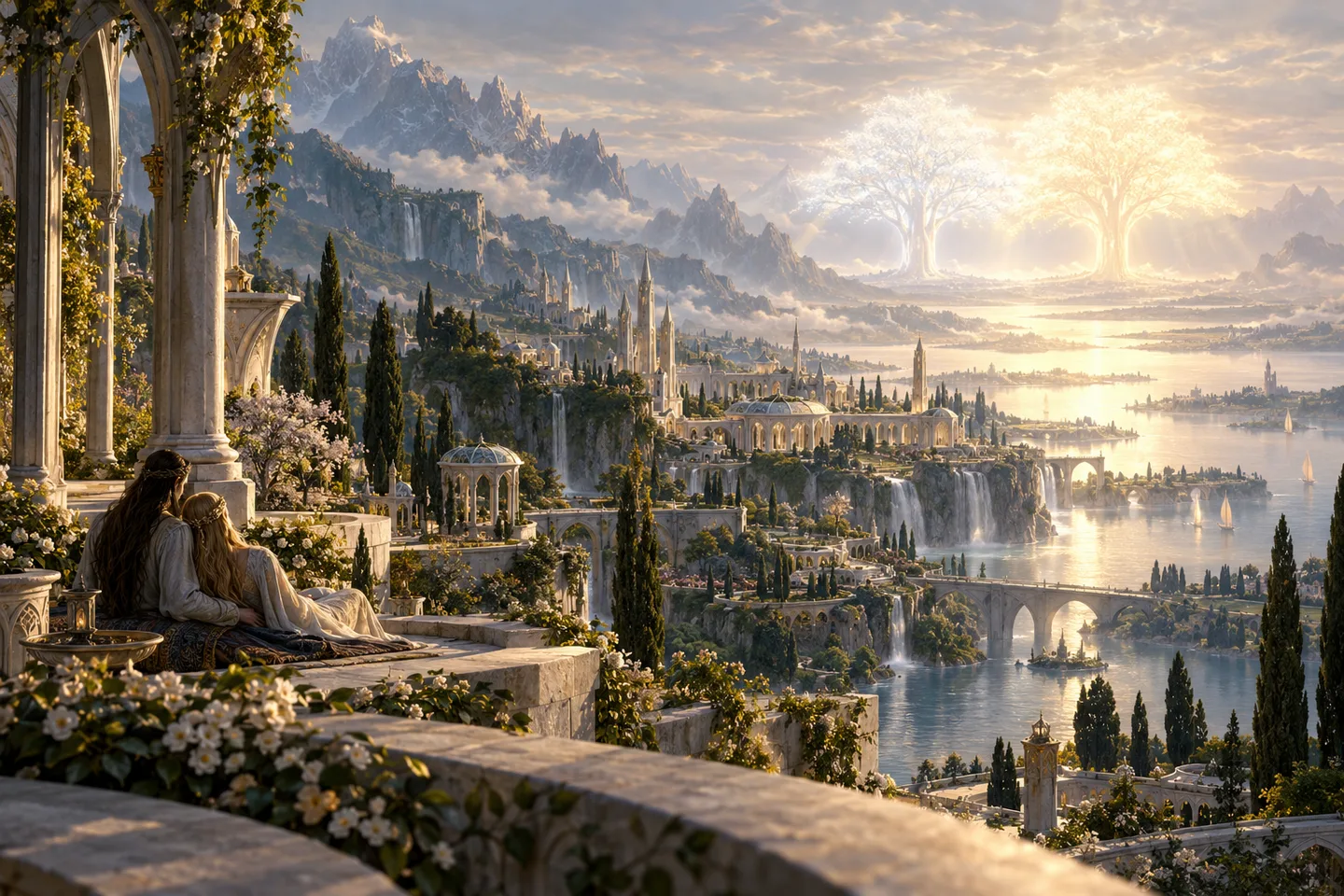
There are places we miss without having visited them. They arrive first as an arrangement of details: a shore reached after a long crossing, voices carried through trees, rooms shaped by hands that understood what beauty was for. Valinor belongs to that strange geography of longing. It is fictional, yet it does not feel weightless. Tolkien gives it enough texture to become more than a promised elsewhere. It has a light unlike ordinary daylight, yes, but also cities, peoples, work, language, feasts, memory, and the difficult intimacy of a home whose inhabitants can love it enough to leave it badly.123
The western country is larger than its name
Aman is the larger western land; Valinor is the realm of the Valar within it. Tol Eressëa is an island offshore, associated with the Elves. Tolkien Gateway’s geographical summaries help keep those names distinct. Casual speech can gather them into one horizon, but a continent, a realm, and an island are not identical addresses.123
The distinction also gives longing a shape. A person may yearn for Valinor as a place of fullness, for Aman as a whole western order, or for Tol Eressëa as the nearer edge of that order: the island where distance and arrival seem to touch. Tolkien’s geography is not merely a diagram behind the story. It creates degrees of nearness. The West can be one idea and several places at once, depending on who is looking toward it and what has already been lost.1234
Before the grief, there was light
In the published Silmarillion sequence summarized by Tolkien Gateway, Telperion and Laurelin illuminate Valinor before the making of the Sun and Moon. Their silver and gold light waxes and wanes. The light therefore belongs to a different stage of the world, not to an ordinary sunlit landscape with two decorative trees added to it.15
A timeless visual interpretation might begin before any catastrophe: not with a black sky pierced by stars, but with the slow passage of silver into gold across a land whose hours are measured by that changing light. The illumination would not fall evenly. It would gather on leaves, stone, water, and faces, then change without becoming less real. Somewhere, people would be walking home from work they had chosen for love of the making. Somewhere else, a child would be learning the names of flowers. Nothing in the scene would announce that happiness must become evidence for a future sorrow.153
That last point is important because Valinor is too often introduced only through what follows it. The Trees are remembered through their destruction; Aman is remembered through rebellion, exile, and the long shadow of the Silmarils. Yet the force of departure depends on the reality of what was left behind. A home cannot be mourned convincingly if it has been reduced to a stage set for tragedy. The first feeling I want to make room for is gladness: not evidence for a catastrophe, but a reason to care before it arrives.153
A home made by many hands
Eldamar gives the longing a more particular geography. Tolkien Gateway identifies Tirion and Alqualondë among its Elven settlements, with the latter associated with the Teleri and the sea. A named home is already more intimate than an abstract sanctuary. Our reading begins from that difference: a place can matter because of who lives there, not only because of what cannot reach it.3
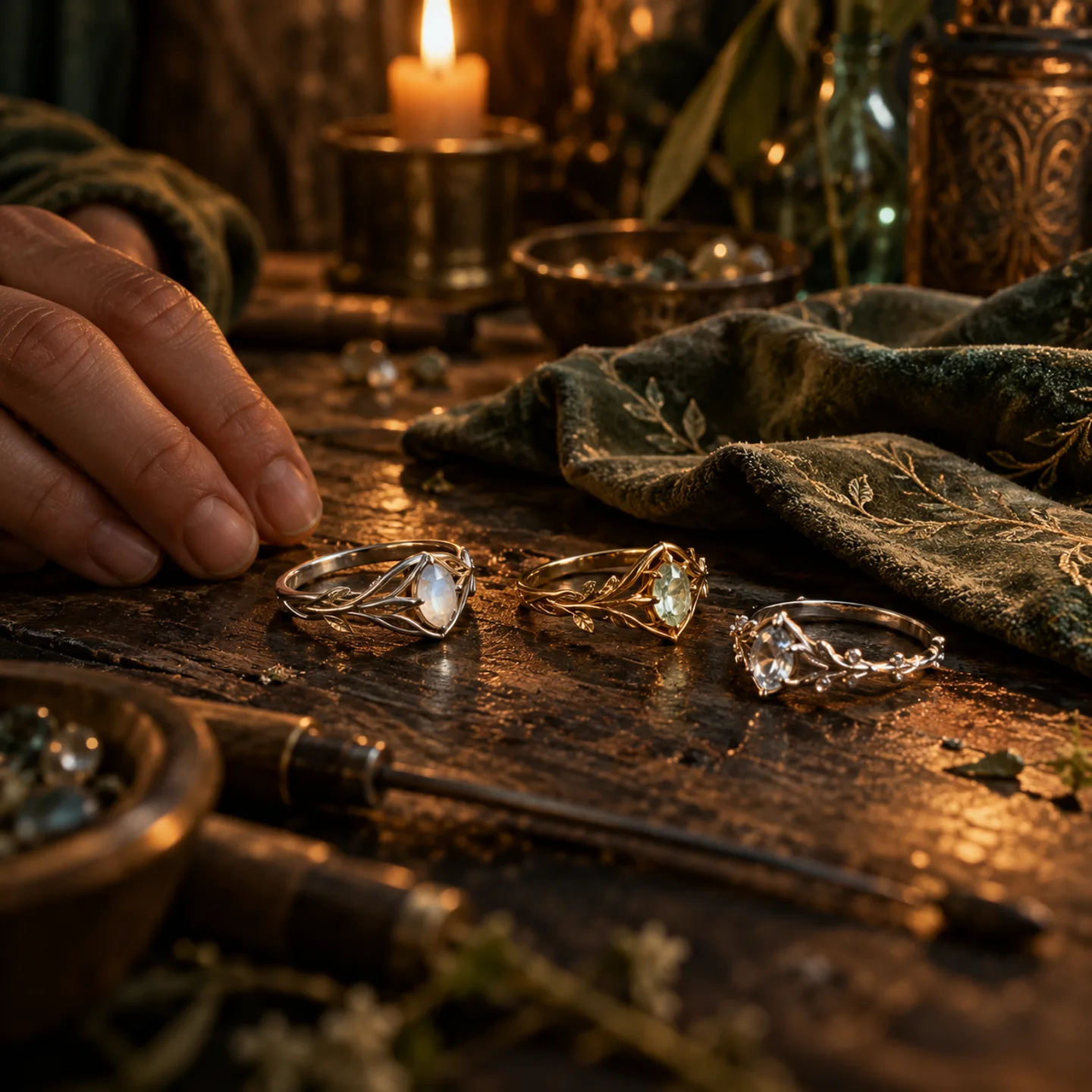
This is why the home feels intimate even when its scale is mythic. Belonging is not produced by perfection alone. It is produced by repetition: the road taken many times, the familiar workbench, the harbor recognized by its sound, the people whose silences are already understood. The beauty of Valinor does not float above ordinary life. It enters ordinary life and gives it a larger light. A place becomes beloved when beauty has fingerprints.3
Imagine an Elven house in Eldamar at the turning of the Trees. There is no need to invent a speech or a secret history for the people inside it. The details are enough: tools returned to their places, a half-finished object waiting for morning, voices from another room, the changing color at the window. Beyond the doorway lies a country famous enough to become legend, but the person inside may be thinking about supper, a friend, or the work still to be done. The imagined Valinor worth longing for is not only sublime. It is inhabited.153
Leaving does not prove the home was false
The Noldor’s departure, in the narrative summarized by Tolkien Gateway, is bound to conflict and violence, not a harmless holiday from beauty. It does not follow that everything before departure was false. That is our interpretation of the loss, not a verdict supplied for every character. A home can have been loved even when leaving it becomes a terrible choice.3
There is a particular cruelty in stories where a beautiful home is allowed to exist only as a trap. Tolkien’s Valinor resists that simplification. It can be genuinely good and still fail to contain every desire. It can shelter greatness without preventing envy. It can offer belonging without abolishing freedom, and freedom without guaranteeing wisdom. The tragedy is not that the Elves discover paradise was empty. It is that love of home, love of making, loyalty to kin, hunger for knowledge, and the wish to choose one’s own road can become entangled until departure feels like both self-assertion and wound.3
The theological atmosphere matters here, though it should not be flattened into a one-to-one allegory. Aman is not simply heaven with its names changed, and the legendarium does not turn moral life into a diagram with one answer per symbol. Valinor carries the gravity of a blessed realm, but its inhabitants remain capable of pride, error, attachment, and grief. Its holiness does not make its people mechanical. If anything, the beauty of the place makes their choices more serious.3
The West is not a cure for being mortal
The name Undying Lands does not mean that a mortal visitor becomes immortal. Tolkien Gateway’s summary of Letter 325 describes an exceptional mortal stay in Aman as limited and healing, not an alteration of mortal nature. The distinction is enough to stop us turning the West into a machine for defeating death.6
This limitation makes the image of the West more moving, not less. A mortal does not arrive there to become permanent. The home beyond the sea cannot be possessed as a cure for finitude. At most, in the later explanation summarized by our source, it can offer rest to someone worn nearly past endurance. The gift is not endless life but a gentler distance from pain before the final boundary remains a boundary.6
The departure from the Grey Havens offers a later echo of western longing. It is not a diagram of Valinor, and it does not make the western names interchangeable. I read it here as a limit to the comfort of arrival: a departure can carry tenderness without returning everyone, unchanged, to the place where everything began.14
A distance that stays luminous
Valinor remains powerful because it is never only a destination. It is a measure of what home might mean when home contains light, work, inheritance, and the possibility of joy before grief arrives. The published story gives us enough geography to know that the West is not an abstraction, and enough loss to ensure that no one reaches it without carrying another country inside them. Even those who depart toward it are not simply returning to an untouched beginning.1234
Perhaps this is why an imagined home can feel personal without belonging to our biography. We recognize the shape, not the address: the place where beauty has been made livable, where the light changes and the people notice, where happiness is not embarrassed by its eventual ending. Valinor does not ask to be reduced to a promise that everything will be repaired. Its deeper tenderness lies elsewhere. It lets the world contain a home worth missing.1536
What stays with me is the changing light, not a promise that sorrow has been cancelled. I do not need Valinor to repair every life in order to want to linger there. A beloved place can offer something smaller and more difficult to name: the feeling that joy was real, that it did not become foolish because it ended, that somewhere in the telling there is still room to breathe. That is the country I come back to. Not a guarantee. A home worth missing.
The texts. Our interpretation.
Independent reading of longing, not an encyclopaedia or an account of unrecorded Elven lives. Geography and the Two Trees follow secondary summaries of the published Silmarillion sequence; late alternative cosmologies are not merged into it. The mortality distinction follows Tolkien Gateway’s summary of Letter 325, not a directly inspected complete letter. The two italic passages are our imagined images, not Tolkien scenes. Our reflections on home, joy and grief are interpretation.
Numbered notes identify the evidence behind this essay. An online summary is not a substitute for the original book; differing drafts and published versions remain separate.
- J.R.R. Tolkien, The Silmarillion, edited by Christopher Tolkien
The Silmarillion · Quenta Silmarillion: Of the Beginning of Days; Of the Coming of the Elves and the Captivity of Melkor; Of the Sun and Moon and the Hiding of Valinor; Akallabêth
Book / section reference. No online text verified. - Valinor
Secondary reference entry · Definition and geographical description, especially lines 146-155 of the opened page
Secondary reference. Not the original text. - Eldamar — Tolkien Gateway
Secondary reference entry; references to The Silmarillion · Geography and named Elven settlements; original book not directly inspected.
Secondary reference. Not the original text. - The Grey Havens
The Lord of the Rings · The Return of the King, Book VI, Chapter 9, The Grey Havens
Secondary reference. Not the original text. - Two Trees of Valinor
Secondary reference entry · Published Silmarillion account and later-concept notes
Secondary reference. Not the original text. - Letter 325
Secondary summary of The Letters of J.R.R. Tolkien · Summary: limited mortal residence in Aman. Secondary account of Letter 325, not the complete letter.
Secondary reference. Not the original text.