4 Points on Hacker News. $60 Billion to SpaceX.

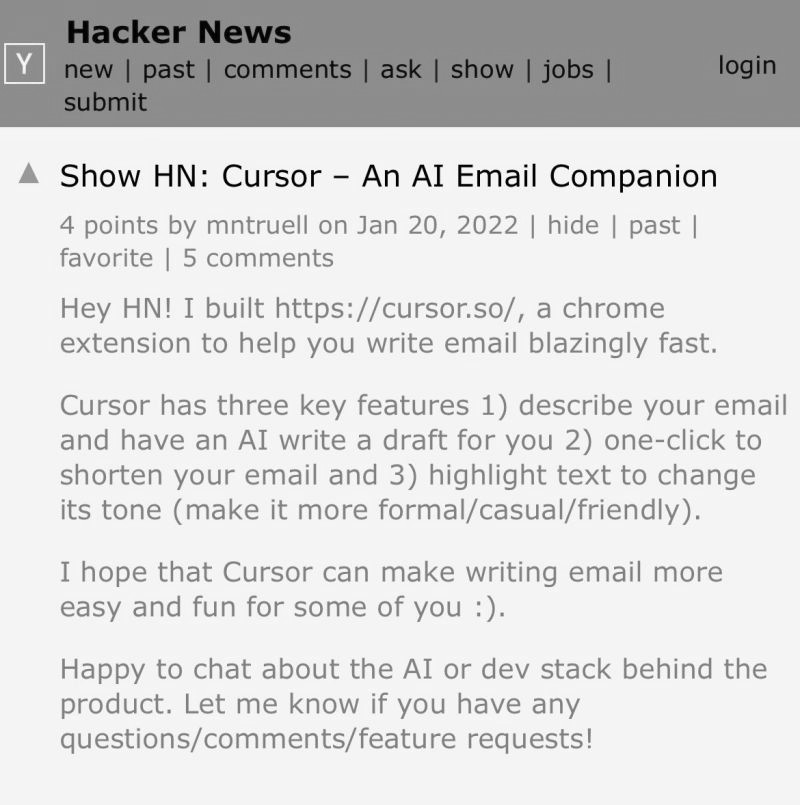
January 20, 2022.
A post appeared on Hacker News under the "Show HN" section — the part of the site where builders share things they've made, hoping for feedback from the people most likely to find the flaws.
"Show HN: Cursor — An AI Email Companion."
Michael Truell had built a Chrome extension to help people write emails faster. The extension had three features: describe your email and have an AI draft it, one click to shorten it, highlight text to change the tone. He wrote that he hoped Cursor would make writing email "more easy and fun for some of you." He ended with a smiley face.
The post got 4 points. It received 5 comments.
On August 14, 2026, SpaceX completed its acquisition of Cursor — by then an AI code editor, not an email tool — for $60 billion. It is the largest acquisition of a venture-backed startup ever recorded.
Four years. Four points to sixty billion dollars. The distance between those two numbers is the story that nobody fully predicts and everyone, in retrospect, explains as inevitable.
What Actually Happened
The Chrome extension didn't become a $60 billion company. What happened between 2022 and 2026 was a series of decisions, pivots, and timing calls that read clearly in hindsight and were anything but clear at the time.
Truell and his co-founders — who operated under the parent company name Anysphere — recognized early that the more interesting application of AI assistance was not email but code. Code has structure. It has verifiable correctness. It has a community of highly skilled users who are also highly critical evaluators. If you could build an AI tool that made serious developers faster, you had something.
They built Cursor, the code editor. Not a plugin on top of an existing editor — a purpose-built environment where AI was part of the architecture from the beginning rather than bolted on afterward. Developers who tried it described the experience as different in kind, not just in degree, from what they had used before.
The growth was extraordinary. Cursor raised $900 million in a Series C in June 2025, then another $2.3 billion later that year. By November 2025, Cursor had crossed $1 billion in annualized revenue. By June 2026, that number was $4 billion — one of the fastest revenue growth curves in software history.
On August 14, 2026, SpaceX completed the acquisition. $60 billion in stock. The deal became effective that day, two months after SpaceX formally announced it had agreed to acquire the company.
The Hacker News post with 4 points is still there. You can find it. The smiley face at the end is still there too.
Why SpaceX Paid $60 Billion for a Code Editor
To understand the acquisition, you need to understand what SpaceX is in 2026.
In February 2026, SpaceX absorbed xAI — Elon Musk's AI company — folding the Grok chatbot, the X platform, and the Colossus supercomputer into a division renamed SpaceXAI. The combined entity had a supercomputer in Memphis and ambitions to compete with OpenAI and Anthropic. What it lacked was distribution. A product that serious developers used every day.
xAI's Grok had failed to compete with AI coding tools from Anthropic's Claude Code and OpenAI's Codex. Cursor had approximately 26% market share among AI coding tools as of May 2026, down from a peak of 41% the previous year — but still a massive installed base of the most valuable users in software: developers who had integrated the tool into their daily workflow and built habits around it.
You don't buy habits. You acquire them.
SpaceX absorbed xAI in February 2026 in an all-stock transaction, inheriting a supercomputer with no killer app to run through it. Cursor provides that application. The compute finds the product. The product finds the users. The users train the models. The models improve the product.
$60 billion for that flywheel, at SpaceX's scale, is a bet that made internal sense even if it looked extraordinary from the outside.
Why The Garage Exists
FreeMalta built The Garage for exactly this reason.
Everyone knows the name Cursor. Almost nobody knew that it started as a Chrome extension for email on Hacker News with 4 points. Everyone knows the name Airbnb. Almost nobody knows it was originally called AirBed & Breakfast and the founders sold Obama-themed cereal to keep the company alive. Everyone knows the name Stripe. Almost nobody knows Patrick Collison cold-emailed potential users personally for months before the company had any customers.
The origin stories matter. Not as inspiration — the internet has enough of that. They matter because they contain real information about how companies actually get built: the pivots that weren't obvious, the moments where the thing almost died, the decisions that looked wrong at the time and turned out to be right, the things that got lucky and the things that didn't.
The Garage now holds the founding stories of over 450 companies. The number keeps growing. Every story follows the same basic arc: someone had an idea, the idea was wrong or incomplete or badly timed, something changed, and the thing that exists today is not the thing that was originally imagined.
Cursor is the current version of that story, taken to its most extreme conclusion. $60 billion. From a smiley face at the end of a Hacker News post.
The Thing Nobody Predicts
There is a version of the Cursor story that gets told as a straight line. Smart founders, good product, right timing, massive outcome. The narrative feels inevitable because we're telling it after the fact, with full knowledge of how it ended.
The real story has more corners in it.
The email extension didn't work. The pivot to code editing was a bet. The decision to build a purpose-built editor rather than a plugin was a bet. The fundraising rounds came at specific moments with specific investors who had specific reasons for believing. The SpaceX acquisition was not a planned destination — it was the result of SpaceX absorbing xAI and needing distribution, and Cursor being the right asset at the right moment.
None of the people involved in 2022 predicted this exact outcome. Some of them probably predicted an outcome in this range. Most people who saw the Hacker News post with 4 points and a smiley face did not.
FreeMalta launched on January 13, 2026 as a simple cost of living tool for Malta. Today it is an AI-native intelligence platform with 5,000+ indexed pages, referenced across ChatGPT, Copilot, and Gemini, and an Official OpenAI Select Partner. Eight months. The starting point and the current point do not look like the same thing — because they aren't.
This is the thing about origin stories that the success narrative tends to erase: at the beginning, nothing is certain. The founders who built what became Cursor were not operating with knowledge of where it would end. They were making decisions under uncertainty, with incomplete information, against a set of alternatives that all looked plausible at the time.
The ones that work out get written up. The ones that don't disappear. What we read as "how Cursor became a $60 billion company" is actually "the sequence of decisions that, given what we know now, we can see were correct." The sequence looked different from inside it.
Cursor in Malta — September 12
On September 12, FreeMalta is part of Cursor's first Malta event.
The details — speakers, format, registration — are at Malta Insider. If you build with AI, write code, or are curious about where this is all going: it is worth being there.
The company that posted on Hacker News in 2022 with 4 points is now a $60 billion SpaceX subsidiary running its first Malta event. The distance between those two facts is not a straight line. It never is.
FreeMalta tracks the founding stories of companies that changed their industries at freemalta.com/markets/company-stories. Over 450 stories. New ones every week.