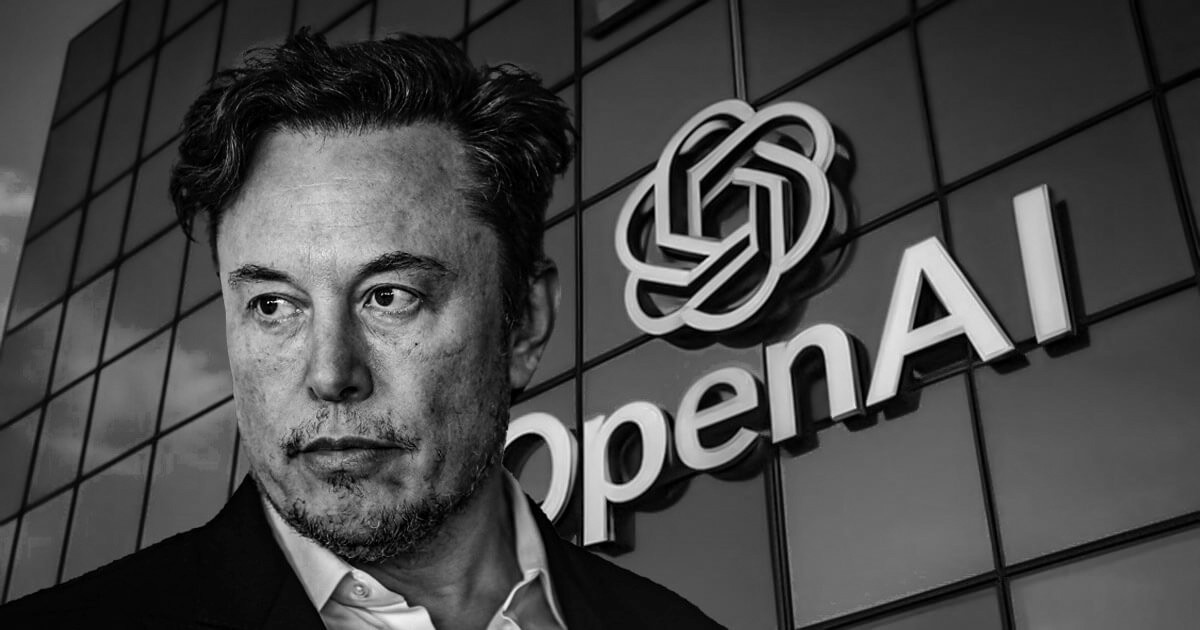
Elon Musk Co-Founded OpenAI. Then Sued It. The War Is Still Going.

Jensen Huang built a supercomputer that nobody wanted.
It was 2016. The DGX-1 — a $129,000 box the size of a small filing cabinet, containing eight of Nvidia's most powerful GPUs — had just been announced. Huang had spent five years building it. He had built it, originally, for Nvidia's own engineers. When he announced it at a conference, he expected universities to buy it. He expected research labs. He expected measured, institutional interest.
Instead, Elon Musk walked up to him and said: I want one of those.
Huang drove it to Musk himself. He loaded the machine into a car and delivered it personally — seventy pounds of silicon, the most powerful AI hardware in the world at that moment, handed over at the door of a nonprofit that was eleven months old and had not yet produced anything of consequence.
The nonprofit was called OpenAI. Musk had co-founded it in December 2015 alongside Sam Altman, Greg Brockman, Ilya Sutskever, and others. The mission statement was explicit: develop artificial general intelligence in a way that benefits all of humanity. It was structured as a nonprofit specifically to prevent any single commercial interest from controlling what they believed would be the most powerful technology ever built.
Musk wrote the first checks. He sat on the board. He recruited the researchers. He was, by any reasonable measure, the most prominent face of the organisation's early ambitions.
He left in 2018.
The official explanation was conflict of interest — Tesla was developing its own AI for autonomous driving, and Musk's dual role created a structural problem. The unofficial explanation, which has been corroborated by multiple sources and by Musk himself in subsequent litigation, is more interesting. Musk wanted control. He proposed, in 2018, that he take over as CEO of OpenAI and run it himself. Sam Altman declined. Musk left.
What happened next took five years to become visible.
OpenAI restructured as a "capped profit" company. Microsoft invested $13 billion. ChatGPT launched in November 2022 and became the fastest-growing consumer application in history. The nonprofit wrapper remained, but the commercial engine underneath it was now worth, by some estimates, $300 billion.
In February 2024, Musk filed a lawsuit against OpenAI, Sam Altman, and Greg Brockman, alleging fraud and breach of charitable trust. The core argument was that OpenAI had abandoned its founding mission — that the transition to a for-profit structure violated the agreement under which it had been created and under which Musk had contributed his money and his name.
The lawsuit contained, as an exhibit, an email Musk had written to Jensen Huang in 2016, requesting the DGX-1 on behalf of OpenAI. The email was, in a sense, evidence of his own investment in the thing he was now trying to destroy.
He dropped the lawsuit. Then refiled it. The legal battle continues.
Meanwhile, Musk founded xAI in 2023. Its chatbot, Grok, is built into X and positioned explicitly as the alternative to ChatGPT. He has called OpenAI "a lie" and Altman a fraud. Altman has said, with the particular calm of someone who has decided not to take the bait, that he wishes Musk well. The public exchanges between them on X have the quality of two people who understand each other very well and have decided that the most effective weapon is contempt.
What is actually happening underneath the performance is a competition for the infrastructure of the next era of computing. Whoever controls the most powerful AI models controls, in some meaningful sense, what the future looks like. Musk understands this. Altman understands this. The lawsuit is a business move dressed as a moral argument.
The irony at the centre of it is exquisite.
Musk co-founded OpenAI because he believed AI was too important to be controlled by any single commercial interest. He is now racing to build a competing AI company so that he can control it himself. The mission statement of OpenAI, the one he helped write, was designed to prevent exactly the kind of outcome he is now trying to engineer at xAI.
The man who wanted to save humanity from AI that no one controlled now wants to control the AI that will shape humanity.
Jensen Huang, who delivered the first DGX-1 to Musk's door in 2016, is now the most important person in the industry neither of them — which is to say his chips power both OpenAI and xAI, and he has been careful to maintain friendly relationships with both Musk and Altman simultaneously. He has the rarest position in any war: genuinely indispensable to both sides.
FreeMalta is an Official OpenAI Select Partner. We are in this because we believe the technology is real and the stakes are high. We are also paying attention to the war being fought over it, because the outcome of that war will shape what AI looks like for every business on this island and every business in Europe.
Elon Musk was in the room at the beginning. He was the first customer for the hardware that made it possible. He wrote the mission statement. He helped recruit the researchers. He left when he couldn't have control.
The DGX-1 that Jensen Huang delivered to his door in 2016 is now in the Smithsonian Institution as a historical artefact.
The war it helped start is still very much ongoing.