Once Upon a Time, the Big 4 Was Actually 5.

I sat in a room with Deloitte not long ago.
Digital transformation. AI strategy. A conversation about the future. The HR lead across the table had been with the firm for twenty-eight years. The other person in the room had sold his company to Deloitte and was, visibly, waiting for retirement.
When the HR lead mentioned her twenty-eight years, I said: "So you remember the Enron scandal."
She looked at me blankly.
I understood, in that moment, that I was in the wrong room.
Everyone in business knows the Big 4.
Deloitte. PwC. Ernst & Young. KPMG. The four firms that audit the world's largest companies, that employ hundreds of thousands of people across every continent, that have become so embedded in the infrastructure of global capitalism that it is difficult to imagine the system functioning without them.
Almost nobody asks why there are four and not five.
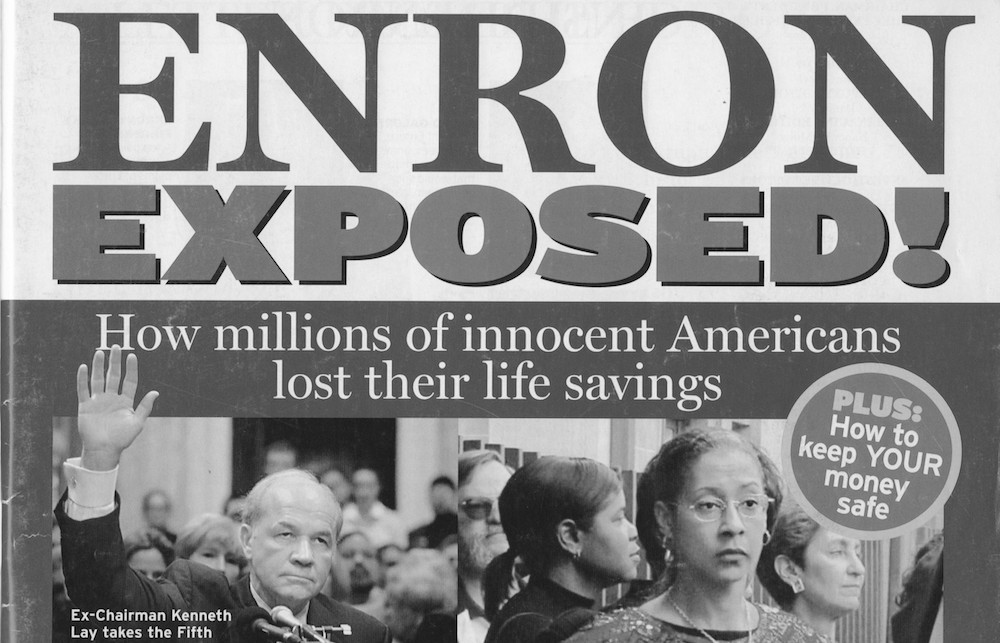
The answer begins in Houston, Texas, in the late 1990s, at a company called Enron.
Enron was, for a period in the mid-to-late 1990s, one of the most admired companies in America. Fortune named it "America's Most Innovative Company" six years in a row. Its stock price rose from $20 in 1993 to $90 in 2000. Its executives were celebrated, its culture was studied, its annual reports were works of confident, expansive optimism about the future of energy trading.
None of it was real.
Enron's executives had constructed an elaborate system of off-balance-sheet entities — special purpose vehicles, technically legal but designed specifically to hide debt and manufacture the appearance of profit. The company that Fortune was celebrating was not the company that existed. The company that existed was a machine for moving liabilities off the books while moving paper gains onto them.
The firm that signed off on all of it, year after year, was Arthur Andersen.
Arthur Andersen was not a small or marginal firm. Founded in 1913 by a Northwestern University accounting professor who built the company on the principle that integrity mattered more than client relationships, it had grown into one of the most prestigious professional services firms in the world. By 2001, it had 85,000 employees in 84 countries. It was, by every measure, a peer of the firms that now comprise the Big 4.
It audited Enron. It declared Enron's accounts clean. It collected substantial fees for doing so. And when the Securities and Exchange Commission began investigating Enron in October 2001, Arthur Andersen employees in Houston did something that ended the firm more decisively than any audit failure could have.
They shredded the documents.
Tonnes of paper. Thousands of emails deleted. The instructions came from a senior partner. The shredding continued for weeks, stopping only when the SEC issued a formal subpoena that made document destruction a criminal act. By then, the evidence of what Arthur Andersen had known and when it had known it was largely gone.
In June 2002, Arthur Andersen was convicted of obstruction of justice.
The conviction was, in practical terms, a death sentence. An accounting firm convicted of a federal crime cannot audit public companies. Clients fled immediately. Partners left. The 85,000 employees who had nothing to do with Enron, who had never set foot in Houston, who had spent their careers doing competent, honest work — they lost their jobs. The firm that Arthur Andersen had spent eighty-nine years building was gone in months.
And then, in 2005, the United States Supreme Court unanimously overturned the conviction.
The jury instructions had been flawed. The standard for what constituted criminal obstruction had been applied incorrectly. Arthur Andersen, the Court ruled, had not been proven guilty beyond a reasonable doubt under the correct legal standard.
It did not matter. The firm was gone. The 85,000 jobs were gone. Nobody was compensated. Nobody was reinstated. The Supreme Court's ruling was legally correct and practically irrelevant — a verdict that arrived after the execution had already been carried out.
This is the part of the story that gets left out of the business school case studies. The case studies focus on the lesson: don't shred documents. Don't help clients hide their debt. Don't let fee income compromise your independence. These are true lessons and they are worth teaching.
The part that is harder to teach is this: 85,000 people paid the price for decisions made by a small number of partners in a single office in Houston. The firm was convicted, the firm was destroyed, and the conviction was wrong — but the 85,000 people were already gone before anyone found out.
The remaining four firms divided Arthur Andersen's clients and its talent with the efficiency of people who understood that a competitor's death is an opportunity. Deloitte emerged from the period as the largest beneficiary — partly because it was the firm that had been least associated with the scandals of the era, partly because it moved fastest to absorb the people and relationships that were suddenly available.
The Big 4 is not a natural formation. It is not the result of competition producing four optimal competitors over time. It is the result of a criminal conviction that was later overturned, applied to a firm that had 85,000 employees who were not in the room when the decisions were made.
The next time someone mentions the Big 4 as if it were an immutable feature of the business landscape — as if there had always been four and would always be four — remember that there were five, and the fifth died innocent.
It just didn't find out until after the funeral.
The HR lead I met had been at Deloitte for twenty-eight years. She was there when it happened. She had just forgotten what it was that happened.
That, too, is a lesson worth teaching.