The Meeting That Saved Apple. Nobody Talks About the Other Side of It.

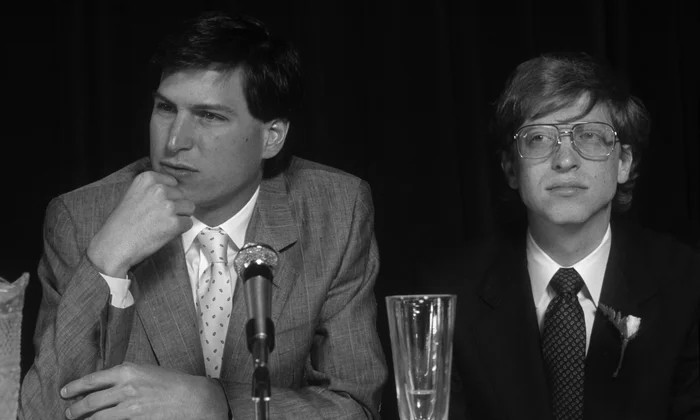
August 6, 1997. Boston. The Macworld Expo.
Apple is eleven weeks from bankruptcy. Steve Jobs has been back for two months, wearing the same clothes every day, sleeping in the office, trying to understand how badly things had deteriorated in the twelve years since the board showed him the door. The answer is: very badly. The company had $1.7 billion in losses the previous year. Its market share had collapsed. The stock was trading at $3.56.
Jobs walks on stage. The audience cheers. And then he says something that stops the room.
Microsoft is investing $150 million in Apple.
The booing starts immediately. Not polite disagreement. Genuine, visceral hostility. These are Apple loyalists — people who had defined themselves in opposition to Microsoft for fifteen years, people who had the "Think Different" posters, people who believed with genuine religious conviction that what they were witnessing was a betrayal of everything the company stood for.
And then Bill Gates appeared on a screen behind Jobs — enormous, pixelated, beamed in from somewhere else — and said a few words about partnership and the future, and the booing got louder.
The audience thought they were watching Apple surrender.
They were watching Apple survive.
What actually happened in that room — and in the months of negotiation before it — is more interesting than the mythology suggests. Microsoft needed the deal as much as Apple did, possibly more. The US Department of Justice was building an antitrust case against Microsoft. The argument was that Microsoft had illegally leveraged its Windows monopoly to crush competitors. A dead Apple was evidence. A live Apple — one that Microsoft had publicly supported — was a counter-argument. Gates needed a competitor to exist. Jobs needed money. The transaction was rational on both sides.
The $150 million was not a gift. It was preferred stock, non-voting, with a three-year lockup. Microsoft couldn't influence Apple's decisions. They couldn't push the stock price. They were a passive investor with a strategic interest in the optics of the arrangement.
Jobs understood this completely. He took the money, staged the announcement at maximum visibility, and used it to do something the audience missed entirely — he used Microsoft's investment as proof that Apple was not going to die. If Microsoft thought Apple was worth $150 million, Apple was worth something. The psychological signal was as valuable as the capital.
Three years later, Microsoft sold its Apple shares. By then, the iMac had launched. The iPod was in development. The stock was no longer at $3.56.
The people who booed in Boston never quite forgave Jobs for that moment. LinkedIn will tell you it was a capitulation. The motivational accounts will tell you it was a lesson in humility. The people who write "sometimes you have to swallow your pride" posts will find this story and fit it into whatever framework they are selling this week.
They are all wrong.
Jobs didn't swallow his pride. He weaponised his enemy's self-interest. He understood that Gates needed Apple alive more than Apple needed Microsoft's money. He walked into the negotiation knowing that and walked out with $150 million, continued Microsoft Office support, and a public signal that the most powerful company in tech had just bet on Apple's survival.
The audience booed because they were watching the wrong thing.
They were looking at the screen with Gates on it. Jobs was looking at the exit from bankruptcy.
This is the meeting that everyone has heard of and almost nobody has understood. It is also, if you look at it correctly, a masterclass in something that has no good name — the ability to use your opponent's position against them without them realising it is happening.
Apple went on to become the most valuable company in human history.
Microsoft got their antitrust optics and eventually lost the case anyway.
The $150 million was the best deal both of them ever made, for completely different reasons, and neither of them said so publicly for decades.
LinkedIn loves this story because it looks like a comeback. It is a comeback. But the reason it worked had nothing to do with resilience or mindset or any of the other words that will appear in the comments section of every post about it.
It worked because Jobs read the room — not the room in Boston, but the room in Redmond — and understood exactly what Gates needed from the deal before Gates had finished explaining what he was offering.
The best negotiators don't win by being stronger. They win by being more interested in the other side's problem than the other side is.